Asked the way someone new to the school paperwork asks
What is rate of pursuit for the GI Bill®?
Rate of pursuit is your load as a share of full time, which VA counts as 14 credits unless your school certifies 12 or 13 for its undergraduates; for graduate courses it is what the school certifies, or 14. GI Bill months are charged at it, so 9 credits of 12 uses three-quarters of a month for each month enrolled. Above half time, housing is paid at it rounded to the nearest 10 percent, and at exactly half time housing pays nothing.
The Short. The answer as a short video, with captions and a transcript.Transcript
Asked, plainly. What is rate of pursuit for the GI Bill? Asked the way someone new to the school paperwork asks
Rate of pursuit is your load as a share of full time, which VA counts as 14 credits unless your school certifies 12 or 13 for its undergraduates; for graduate courses it is what the school certifies, or 14.
GI Bill months are charged at it, so 9 credits of 12 uses three-quarters of a month for each month enrolled.
Above half time, housing is paid at it rounded to the nearest 10 percent, and at exactly half time housing pays nothing.
The law behind it. 38 CFR 21.9641, 38 CFR 21.9561. The full answer is at wegotyou1776.com/questions
We Got You 1776. Plan around your education benefits. wegotyou1776.com/questions
How does this apply to you?
If you handle the school paperwork
Rate of pursuit is credits over what the school certifies as full time, 12 or 13, or 14 if it certifies neither. For graduate courses, full time is what the school certifies, or 14 credits.
A lighter load is charged at your rate of pursuit, and housing stops at exactly half time. Above that it is paid at the rate rounded to the nearest 10 percent.
your credits ÷ the credits your school counts as full time
Months charged for a term
the months enrolled × your rate of pursuit
Housing above half time
the housing figure for your campus × your eligibility tier × your rate of pursuit rounded to the nearest 10 percent
What does rate of pursuit mean?
The share of full time you are taking. VA counts 14 credits as full time unless your school certifies 12 or 13 for its undergraduates; for graduate courses it is what the school certifies, or 14.
How does VA figure my housing if I take 9 credits?
Where 12 is full time, 9 or 10 credits is 80 percent, so housing is paid at 80 percent. Above half time, VA rounds the rate of pursuit to the nearest 10 percent.
How does rate of pursuit drive GI Bill months and housing?
Rate of pursuit is the share of full time a student is taking: the credits taken divided by the credits the school counts as full time. VA counts 14 college credits a term as full time unless the school certifies that its undergraduates are full time at 12 or 13; then that number is full time. At 12, VA counts 9 to 11 credits as three-quarter time and 6 to 8 as half time. For graduate courses, full time is what the school certifies, or 14 credits.
It sets how fast months are used. GI Bill months are charged at the rate of pursuit, so 9 credits of 12 uses three-quarters of a month for each month enrolled. Post-9/11 entitlement is charged for each day of a certified enrollment at the rate of pursuit, so a break with no enrollment is not charged.
It sets housing too. Housing pays only above half time; at exactly half time, 6 credits where 12 is full time, it pays nothing. Above half time it is paid at the rate of pursuit rounded to the nearest 10 percent: 7 credits of 12 is 60 percent, 8 is 70, 9 or 10 is 80, 11 is 90. How much of the housing figure is paid also depends on the eligibility tier.
A short session is measured by its length. A summer or other short session counts credits times 18, or 12 for quarter hours, divided by the weeks in the session; breaks of 7 days or more are left out, and 4 or more leftover days count as a week. So a few credits in a short session can measure as a heavier load than the same credits over a full term.
The last term is the exception for housing. In the final term, a Post-9/11 student enrolled more than half time gets the full housing allowance, for terms starting on or after January 1, 2025.
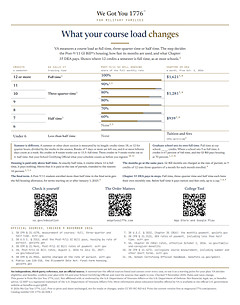
Post-9/11 GI Bill housing share of the full monthly rate
Chapter 35 DEA a month, from Oct. 1, 2026
12 or more
Full time
100%
$1,621
11
Three-quarter time
90%
$1,281
10
80%
9
80%
8
Half time
70%
$939
7
60%
6
None
Under 6
Less than half time
None
Tuition and feesonly, up to a cap
Summer is different. A summer or other short session is measured by its length: credits times 18, or 12 for quarter hours, divided by the weeks in the session. Breaks of 7 days or more are left out, and 4 or more leftover days count as a week. Six credits in 8 weeks works out to 13.5: full time. Three credits in 9 weeks works out to 6: half time. Ask your School Certifying Official what your schedule counts as before you register.
Graduate school sets its own full time. Full time at our school: ______ credits. Where a school sets 9 as full time, 6 credits is 67 percent of full time, and the GI Bill pays housing at 70 percent.
DEA pays in steps by training time: where the school certifies 12 credits as full time, 9 to 11 is three-quarter and 6 to 8 half. Below half time the monthly payment covers tuition and fees only, up to a cap.
Housing pays only above half time. At exactly half time, 6 credits where 12 is full time, it pays nothing.
Above half time, housing is paid at the rate of pursuit rounded to the nearest 10 percent: 7 credits of 12 is 60 percent, 8 is 70, 9 or 10 is 80, 11 is 90.
GI Bill months are charged at the rate of pursuit, so 9 credits of 12 uses three-quarters of a month for each month enrolled.
In the final term, a Post-9/11 student enrolled more than half time gets the full housing allowance, for terms starting on or after January 1, 2025.
From October 1, 2026, DEA pays $1,621 a month full time, $1,281 at three-quarter time and $939 at half time.
A summer or other short session is measured by its length: credits times 18, or 12 for quarter hours, divided by the weeks in the session; breaks of 7 days or more are left out, and 4 or more leftover days count as a week. So in summer, full time is not 12 credits.
The GI Bill’s monthly housing payment: DoD’s Basic Allowance for Housing for an E-5 with dependents at the ZIP code of the campus where the student attends most classes. Schools abroad use one foreign rate instead, and a U.S. school’s campus abroad may not get the home campus rate.
How much of a full load you are carrying, as a percentage. Nine credits where 12 is full time is 75 percent. The GI Bill pays housing by it, rounded to the nearest 10 percent, and only when it is over 50 percent. It also sets how fast your GI Bill months get used. DEA uses steps instead: full, three-quarter, half, and less than half.
How VA measures a course load. VA counts 14 credits a term as full time unless the school certifies 12 or 13 for its undergraduates. Where 12 is full time, 9 to 11 is three-quarter time and 6 to 8 is half time; for graduate work, full time is what the school certifies, or 14 credits. Chapter 35 DEA pays in steps by it, and the GI Bill pays housing only above half time.
The months of a benefit you have to use. The Post-9/11 GI Bill gives up to 36. DEA gives up to 36 if school started on or after August 1, 2018, and up to 45 if it started before. The GI Bill charges its months at your rate of pursuit, so 9 credits of 12 uses three-quarters of a month for each month enrolled.
From The Order Matters, The Terms, Plainly, and terms added or reworded here since, which go into the book at its next update.
How the We Got You 1776 site delivers and checks the rules: dated pages, one register of sources, and Questions from the Field, one question at a time.