Asked the way a student thinking about college asks
Can I use scholarships and grants on top of the GI Bill®?
Yes, grants and scholarships sit on top of VA benefits within the school’s cost of attendance, so file the FAFSA every year. Since May 19, 2026 a student gets no Pell Grant for an award year in which non-Federal grants and scholarships reach the cost of attendance; VA benefits are Federal and do not count toward it. At a public school, the GI Bill at the 100 percent level pays the net cost of in-state tuition and fees, after any waiver and any aid paid to the school only for tuition and fees.
How much aid fits on top depends on your situation, including the school’s cost of attendance, whether a scholarship is paid only for tuition and fees, your state’s own programs, and which benefit you are using. Only you can weigh it for your family.
Further into this question
The Short. The answer as a short video, with captions and a transcript.Transcript
Asked, plainly. Can I use scholarships and grants on top of the GI Bill? Asked the way a student thinking about college asks
Yes, grants and scholarships sit on top of VA benefits within the school’s cost of attendance, so file the FAFSA every year.
Since May 19, 2026 a student gets no Pell Grant for an award year in which non-Federal grants and scholarships reach the cost of attendance; VA benefits are Federal and do not count toward it.
At a public school, the GI Bill at the 100 percent level pays the net cost of in-state tuition and fees, after any waiver and any aid paid to the school only for tuition and fees.
The law behind it. 34 CFR 690.5, 38 U.S.C. 3313. The full answer is at wegotyou1776.com/questions
We Got You 1776. Plan around your education benefits. wegotyou1776.com/questions
How does this apply to you?
If you are the student
File the FAFSA every year, even with the GI Bill or DEA paying. Grants and scholarships sit on top of VA benefits within the cost of attendance. Since May 19, 2026 a student gets no Pell Grant for an award year in which non-Federal grants and scholarships reach it; VA benefits are Federal and do not count toward it.
Look at your state’s own scholarships and tuition waivers too. At a public school, a waiver or aid paid to the school only for tuition and fees comes off first, and the GI Bill at the 100 percent level pays the net cost that is left.
Public schools must charge covered Veterans and family members in-state tuition to stay approved for the GI Bill. At the 100 percent level the GI Bill pays the net cost of it, and grants and scholarships sit on top within the cost of attendance.
Does a scholarship lower what the GI Bill pays at a public school?
It can. At the 100 percent level the GI Bill pays the net cost of in-state tuition and fees at a public school: what is left after any tuition waiver or reduction and any aid paid to the school only for tuition and fees.
Is there a limit to how much aid I can stack on VA benefits?
Yes, the school’s cost of attendance. Grants and scholarships sit on top of VA benefits within it, and since May 19, 2026 a student gets no Pell Grant for an award year in which non-Federal grants and scholarships reach it.
How do scholarships and grants fit with VA education benefits?
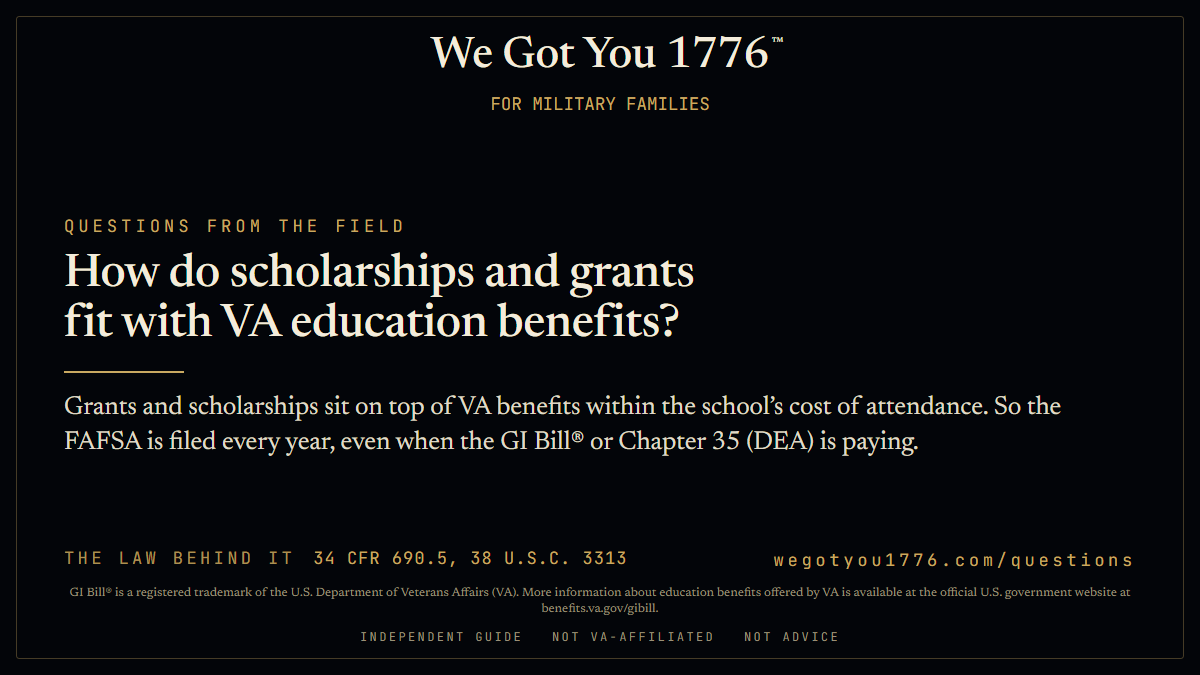
Grants and scholarships sit on top of VA benefits within the school’s cost of attendance. So the FAFSA is filed every year, even when the GI Bill or Chapter 35 (DEA) is paying. Many states have their own scholarships and tuition waivers, and The Order Matters works its example with Florida Bright Futures.
The Pell Grant has a ceiling of its own. Since May 19, 2026 a student gets no Pell Grant for an award year in which non-Federal grants and scholarships reach the cost of attendance. VA benefits are Federal and do not count toward that cutoff; non-Federal grants and scholarships that reach the cost of attendance end the Pell Grant for that award year.
At a public school, the GI Bill pays tuition a set way. Public schools must charge covered Veterans and family members in-state tuition to stay approved for the GI Bill. At the 100 percent level the Post-9/11 GI Bill pays the full net cost of in-state tuition and fees: what is left after any tuition waiver or reduction and any aid paid to the school only for tuition and fees. How much of the tuition it pays depends on how long the member served, the eligibility tier.
Chapter 35 is paid another way. DEA pays a monthly payment directly to the student, who pays the school. At half time or more no rule reduces DEA for grants, scholarships or a state tuition waiver; VA’s list of DEA reductions names a felony prison term, short apprenticeship months and withdrawals. Below half time DEA pays the lesser of the school’s tuition and fees or the full-time rate.
So other aid fits differently on each benefit. On the GI Bill at a public school, aid paid to the school only for tuition and fees lowers the net cost the GI Bill pays. On DEA at half time or more, no rule reduces the monthly payment for it. On both, grants and scholarships sit on top of VA benefits within the cost of attendance.
The Post-9/11 education benefit: up to 36 months that pay tuition and fees to the school, a monthly housing allowance set by the campus ZIP code, and a payment for books and supplies, by the credit up to a yearly cap. How much of the tuition and housing it pays depends on how long the member served (the eligibility tier).
Chapter 35 DEA (Survivors’ and Dependents’ Educational Assistance)
A VA program for the spouse or child of a Veteran VA has found permanently and totally disabled by a service-connected disability, or who died of one or in the line of duty. It pays a monthly payment directly to the student, who pays the school, in steps by training time, and has no housing allowance or book stipend.
How VA measures a course load. VA counts 14 credits a term as full time unless the school certifies 12 or 13 for its undergraduates. Where 12 is full time, 9 to 11 is three-quarter time and 6 to 8 is half time; for graduate work, full time is what the school certifies, or 14 credits. Chapter 35 DEA pays in steps by it, and the GI Bill pays housing only above half time.
A school’s official estimate of a year’s full cost. The ceiling your total aid package can reach, and the line that decides Pell when state, school, and private grants add up to it.
From The Order Matters, The Terms, Plainly, and terms added or reworded here since, which go into the book at its next update.
How the We Got You 1776 site delivers and checks the rules: dated pages, one register of sources, and Questions from the Field, one question at a time.
Published by We Got You 1776, LLC.
Sources (15)
The official sources this answer is built on, the law first, then the official pages.