Asked the way a parent thinking about transferring asks
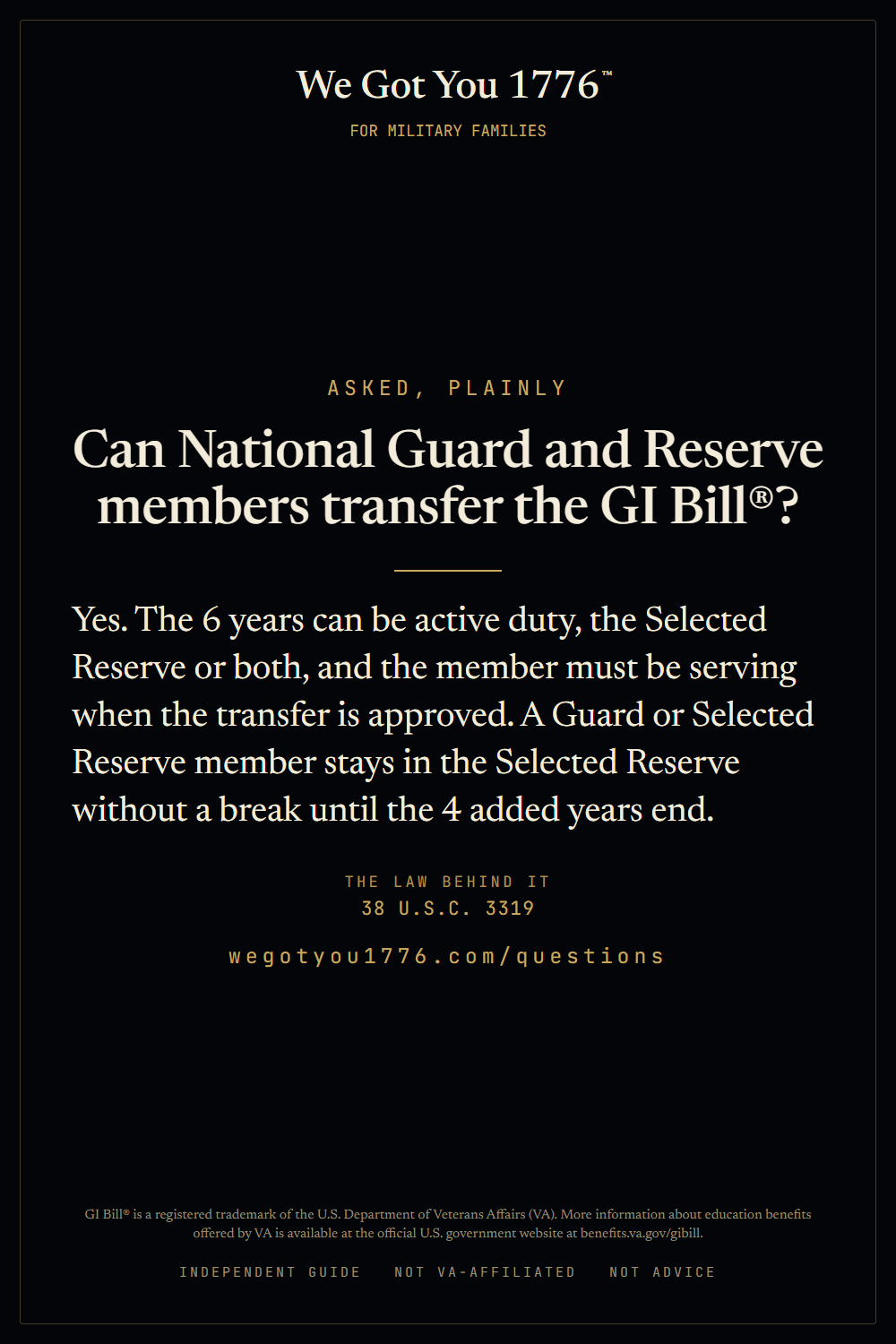
Can National Guard and Reserve members transfer the GI Bill®?
Yes, the 6 years can be active duty, the Selected Reserve or both, and the member must be serving when the transfer is approved. A Guard or Selected Reserve member must stay in the Selected Reserve without a break until the 4 added years end. Only the Post-9/11 GI Bill can be transferred, and it is for service on active duty after September 10, 2001: at least 90 days, or a Purple Heart, or 30 continuous days and a discharge for a service-connected disability.
The Short. The answer as a short video, with captions and a transcript.Transcript
Asked, plainly. Can National Guard and Reserve members transfer the GI Bill? Asked the way a parent thinking about transferring asks
Yes, the 6 years can be active duty, the Selected Reserve or both, and the member must be serving when the transfer is approved.
A Guard or Selected Reserve member must stay in the Selected Reserve without a break until the 4 added years end.
Only the Post-9/11 GI Bill can be transferred, and it is for service on active duty after September 10, 2001: at least 90 days, or a Purple Heart, or 30 continuous days and a discharge for a service-connected disability.
The law behind it. 38 U.S.C. 3319. The full answer is at wegotyou1776.com/questions
We Got You 1776. Plan around your education benefits. wegotyou1776.com/questions
How does this apply to you?
If you are deciding whether to transfer
If you are in the Guard or Reserve and deciding, the 4 added years are served in the Selected Reserve without a break, and the transfer is requested through milConnect while you are serving.
Once months are transferred, they can be moved among family members already named, or revoked if VA has not paid them, in milConnect, even after you leave.
For a Guard or Reserve audience: the 6 years can be active duty, the Selected Reserve or both. Only the Post-9/11 GI Bill can be transferred, and requesting a transfer converts a Montgomery GI Bill member to it, which cannot be undone.
Yes, a Selected Reserve member who has the Post-9/11 GI Bill and at least 6 years of service, is serving when the transfer is approved and agrees to 4 more years in the Selected Reserve. Service in the Selected Reserve counts toward the 6 years, alone or with active duty.
I’m in the Guard with 6 years, can I give my GI Bill to my kids?
Yes, if you have the Post-9/11 GI Bill, agree to 4 more years and request it through milConnect while serving. You stay in the Selected Reserve without a break until those 4 years end, and a child can start using the months once you have served 10 years.
What if I leave the Selected Reserve before the 4 years end?
If the member does not finish the added service, the family loses the transferred months, and what VA already paid is an overpayment the member alone owes. VA lists exceptions, among them illness or injury, a hardship discharge and a reduction in force.
Does the Individual Ready Reserve count for a GI Bill transfer?
The 6 years can be active duty, the Selected Reserve or both. After moving to the Individual Ready Reserve, a member cannot start a transfer or add a family member unless a family member already named dies.
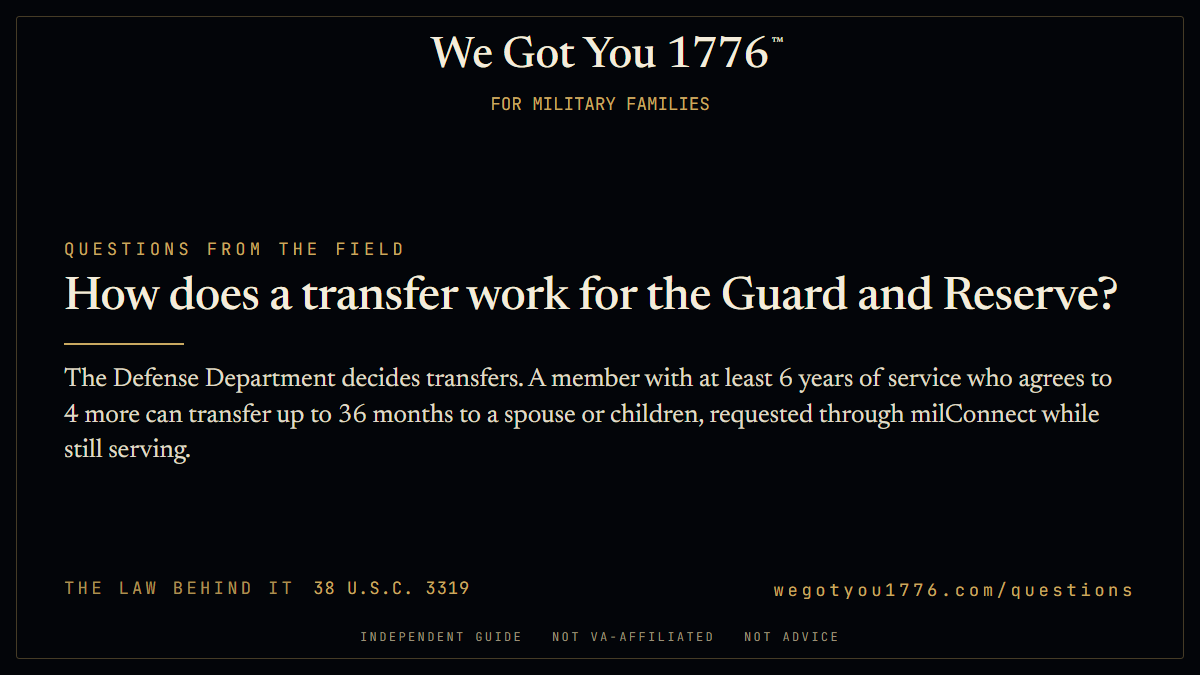
How does a transfer work for the Guard and Reserve?
The Defense Department decides transfers. A member with at least 6 years of service who agrees to 4 more can transfer up to 36 months to a spouse or children, requested through milConnect while still serving.
For the Guard and Reserve, the 6 years can be active duty, the Selected Reserve or both, and the member must be serving when the transfer is approved. A Guard or Selected Reserve member must stay in the Selected Reserve without a break until the 4 added years end. There is no maximum years of service for a transfer.
Only the Post-9/11 GI Bill can be transferred. Requesting a transfer converts a member with the Montgomery GI Bill (Chapter 30 or 1606) to the Post-9/11 GI Bill, and that cannot be undone.
The added service is the condition. If the member does not finish it, the family loses the transferred months, and what VA already paid is an overpayment the member alone owes; since January 2, 2025 the family member is not liable. VA lists exceptions, among them death, illness or injury, a hardship discharge and a reduction in force. A Purple Heart recipient does not need the years of service or the added service.
Leaving narrows what can start. After separating, retiring or moving to the Individual Ready Reserve, a member cannot start a transfer or add a family member unless a family member already named dies. Months can still be moved among family members already named, revoked if VA has not paid them, or restored, in milConnect.
Months go to a spouse, children or both, each enrolled in DEERS, and a child can start using them only after the parent has served 10 years. After the branch approves the transfer, each family member applies to VA, online or with VA Form 22-1990e, and gets a Certificate of Eligibility.
The Post-9/11 education benefit: up to 36 months that pay tuition and fees to the school, a monthly housing allowance set by the campus ZIP code, and a payment for books and supplies, by the credit up to a yearly cap. How much of the tuition and housing it pays depends on how long the member served (the eligibility tier).
Giving Post-9/11 GI Bill months to a spouse or children, the member’s dependents in DEERS. The Defense Department decides it: a member with at least 6 years of service who agrees to 4 more can transfer up to 36 months, requested through milConnect while still serving. VA’s rule calls it transfer of entitlement.
VA’s letter that a benefit is yours to use. A family member using transferred months gets one after applying to VA, online or with VA Form 22-1990e. VA sends it electronically, with mail as an option.
From The Order Matters, The Terms, Plainly, and terms added or reworded here since, which go into the book at its next update.
How the We Got You 1776 site delivers and checks the rules: dated pages, one register of sources, and Questions from the Field, one question at a time.
Published by We Got You 1776, LLC.
Sources (12)
The official sources this answer is built on, the law first, then the official pages.