Asked the way an instructor building a lesson asks
What does the GI Bill® Comparison Tool show?
VA’s GI Bill Comparison Tool shows each school’s approval, its housing figure, Yellow Ribbon participation and caution flags. VA approves each program at a school, and the tool shows which ones it has approved. VA publishes the tool’s data as open data.
The Short. The answer as a short video, with captions and a transcript.Transcript
Asked, plainly. What does the GI Bill Comparison Tool show? Asked the way an instructor building a lesson asks
VA’s GI Bill Comparison Tool shows each school’s approval, its housing figure, Yellow Ribbon participation and caution flags.
VA approves each program at a school, and the tool shows which ones it has approved.
VA publishes the tool’s data as open data.
The source behind it. VA.gov. The full answer is at wegotyou1776.com/questions
We Got You 1776. Plan around your education benefits. wegotyou1776.com/questions
How does this apply to you?
If you are building a lesson
For a class, the tool shows each school’s approval, housing figure, Yellow Ribbon participation and caution flags, all from VA. Material VA produces on its websites is not copyright protected, and VA publishes the tool’s data as open data.
The tool shows the housing figure for each school, and the housing allowance follows the ZIP code of the campus where you attend most classes. All-online study pays half the national average instead.
Where can I see a school’s GI Bill housing allowance?
On VA’s GI Bill Comparison Tool, which shows each school’s housing figure. The housing allowance is DoD’s Basic Allowance for Housing for an E-5 with dependents at the ZIP code of the campus where the student attends most classes.
Does the Comparison Tool show which schools do Yellow Ribbon?
Yes. It shows each school’s Yellow Ribbon participation. Yellow Ribbon is a voluntary agreement in which a school and VA share tuition and fees above what the Post-9/11 GI Bill pays.
Yes. Material VA produces on its websites is not copyright protected, because works of the U.S. Government are not copyrighted, and VA publishes the Comparison Tool data as open data.
VA’s GI Bill Comparison Tool, on VA.gov, shows each school’s approval, its housing figure, its Yellow Ribbon participation and its caution flags. It is VA’s own tool, and VA publishes the datasets behind it as open data.
Approval comes first. VA approves programs at a school, so the question a student asks is whether the program they want is approved at the school they want. VA’s page for Chapter 35 (DEA) sends families to the Comparison Tool to find which programs VA has approved, or to the school’s certifying official, who certifies enrollment to VA and can talk through a plan. VA decides eligibility and months.
The housing figure is the Post-9/11 GI Bill’s monthly housing allowance for that campus. It is DoD’s Basic Allowance for Housing for an E-5 with dependents at the ZIP code of the campus where the student attends most classes. All-online study pays half the national average housing allowance instead, and one in-person class keeps the local rate.
Yellow Ribbon participation tells whether the school takes part in Yellow Ribbon, a voluntary agreement in which a school and VA share tuition and fees above what the Post-9/11 GI Bill pays. The school sets how much it pays a student a year and for how many students, and VA matches it. It needs the 100 percent level, and only participating schools take part.
A public school’s approval is also tied to what it charges. Public schools must charge covered Veterans and family members in-state tuition to stay approved for the GI Bill, the Veterans Choice Act requirement. A student on transferred months is paid at the same rate as the person who transferred them, though a spouse using transferred months gets no housing allowance while the member is on active duty.
The tool is public information. Material VA produces on its websites is not copyright protected, because works of the U.S. Government are not copyrighted, so a teacher or a briefer can put the tool in front of a class and walk through a school with it.
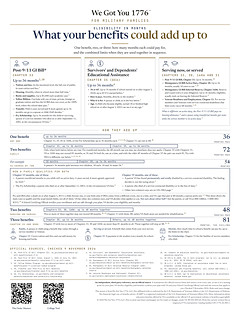
The Post-9/11 GI Bill pays up to 36 months of benefits.
It pays tuition and fees to the school, a monthly housing allowance, and up to $1,000 a year for books and supplies, $41.67 a credit for up to 24 credits.
The Post-9/11 GI Bill pays no housing allowance to a member on active duty, or to a spouse using transferred months while the member is on active duty.
The Defense Department decides transfers. A member with at least 6 years of service who agrees to 4 more can transfer up to 36 months to a spouse or children, requested through milConnect while still serving.
A parent can split the months among family members in any amount and change the split later, for months VA has not yet paid out.
DEA (Chapter 35) is for the spouse or child of a Veteran VA has found permanently and totally disabled by a service-connected disability, or who died of one or in the line of duty, plus less common cases VA lists (missing, captured or detained, hospitalized).
DEA pays up to 36 months if school started on or after August 1, 2018, and up to 45 if it started before.
DEA pays a monthly payment directly to the student, who pays the school. It has no housing allowance or book stipend.
A child who became eligible, turned 18 or finished high school on or after August 1, 2023 can use DEA at any age with no time limit. Otherwise a child generally uses it between 18 and 26.
The Fry Scholarship is for the child or surviving spouse of a service member who died in the line of duty on active duty on or after September 11, 2001; of a Selected Reserve member who died in the line of duty or from a service-connected disability; or, for terms that start before October 1, 2027, of a member who died from a service-connected disability within 120 days of leaving service.
Fry pays up to 36 months at the Post-9/11 GI Bill's full rate: tuition and fees, housing and books.
Yellow Ribbon is a voluntary agreement in which a school and VA share tuition and fees above what the Post-9/11 GI Bill pays. The school sets how much it pays a student a year and for how many students, and VA matches it. It needs the 100 percent level, and only participating schools take part.
The Montgomery GI Bill Active Duty (Chapter 30) and Selected Reserve (Chapter 1606) pay up to 36 months each, and Veteran Readiness and Employment (Chapter 31) up to 48.
VA pays one education benefit at a time. A person eligible for more than one chooses which to use, and can use them one after another.
Chapter 35 combined with other VA education programs is limited to 81 months.
A family holding 36 months of each can use both in full, one at a time: 72 months, inside the 81.
Two or more programs from your own service (Chapters 30, 33 and 1606 among them) are limited to 48 months together, and Chapter 31 with them to 48 unless VA finds more are needed.
Public Law 112-154, section 401, raised the Chapter 35 limit from 48 to 81 months effective October 1, 2013. VA amended 38 CFR 21.4020 to match on July 31, 2025.
Fry with DEA: after a line-of-duty death on or after August 1, 2011, a child chooses one, or uses both only when DEA comes from a different event, which VA caps at 48 months; before that date, both, capped at 81. A spouse picks one and cannot switch. VA's 48 sits against the 81 in 38 U.S.C. 3695(c) and 38 CFR 21.4020(c).
Housing pays only above half time. At exactly half time, 6 credits where 12 is full time, it pays nothing.
The School Certifying Official certifies enrollment to VA and can talk through a plan. VA decides eligibility and months.
VA's education line is 888-GIBILL-1 (888-442-4551), Monday through Friday, 8:00 a.m. to 7:00 p.m. Eastern.
The Post-9/11 education benefit: up to 36 months that pay tuition and fees to the school, a monthly housing allowance set by the campus ZIP code, and a payment for books and supplies, by the credit up to a yearly cap. How much of the tuition and housing it pays depends on how long the member served (the eligibility tier).
Giving Post-9/11 GI Bill months to a spouse or children, the member’s dependents in DEERS. The Defense Department decides it: a member with at least 6 years of service who agrees to 4 more can transfer up to 36 months, requested through milConnect while still serving. VA’s rule calls it transfer of entitlement.
Chapter 35 DEA (Survivors’ and Dependents’ Educational Assistance)
A VA program for the spouse or child of a Veteran VA has found permanently and totally disabled by a service-connected disability, or who died of one or in the line of duty. It pays a monthly payment directly to the student, who pays the school, in steps by training time, and has no housing allowance or book stipend.
A voluntary agreement in which a school and VA share tuition and fees above what the Post-9/11 GI Bill pays. The school sets how much it pays a student a year and for how many students, and VA matches it. It needs the 100 percent level.
The GI Bill’s monthly housing payment: DoD’s Basic Allowance for Housing for an E-5 with dependents at the ZIP code of the campus where the student attends most classes. Schools abroad use one foreign rate instead, and a U.S. school’s campus abroad may not get the home campus rate.
How the We Got You 1776 site delivers and checks the rules: dated pages, one register of sources, and Questions from the Field, one question at a time.
Published by We Got You 1776, LLC.
Sources (24)
The official sources this answer is built on, the law first, then the official pages.