Asked the way an instructor briefing education benefits asks
Is there a 16-year limit to transfer the GI Bill®?
No: since December 20, 2019 the law has barred any maximum years of service for a GI Bill transfer, ending the 16-year cap DoD announced in 2018. Unless the member has a Purple Heart, it still takes at least 6 years served and 4 more agreed, and DoD’s guide says the member must be eligible to be retained for those 4. The request is made while serving, so a member who has retired or separated cannot start one.
Whether 4 more years is worth a late transfer depends on your situation, including how long your branch can keep you, your retirement plans, the ages of your children, and the other benefits your family may hold. Only you can weigh it for your family.
Transferred months, laid out for the student who uses them.
College Tool plans with the months transferred to the student: each phase’s school, benefit and months, and what is left.
5.0 on the App Store. Free to start. A one-time purchase unlocks the full phase approach.
Put both dates on the slide: the Defense Department announced the cap in 2018, and the law has barred any maximum since December 20, 2019. The cites are 38 U.S.C. 3319(j)(3) and section 578 of the FY2020 defense act. Then give the limit a senior member meets: DoD’s guide says the member must be eligible to be retained for the 4 added years.
With many years in, settle retention first. DoD’s guide says you must be eligible to be retained for the 4 added years and not kept from serving them by policy or law, and length of service by itself is no longer a bar. A Purple Heart recipient does not need the added service and still asks while serving.
If you left the service without asking because of the cap, the 2019 law does not open a transfer now. After separating, retiring or moving to the Individual Ready Reserve, a member cannot start one.
I have 18 years in. Can I still transfer my GI Bill?
Eighteen years does not rule out a GI Bill transfer. You agree to serve 4 more, which takes you to about 22, and DoD’s guide says you must be eligible to be retained for those years and not kept from serving them by policy or law. The request goes in milConnect while you are still serving. A Purple Heart recipient does not need the added service.
In 2019 they told me I had too many years. Can I ask now?
If you are still serving, you can ask: the years you have are no longer a bar. The rest of the rules apply, among them 4 more years you can be retained for, which a Purple Heart recipient does not need. If you have separated, retired or moved to the Individual Ready Reserve, you cannot start a transfer.
Section 578 of the FY2020 defense act, Public Law 116-92. It added 38 U.S.C. 3319(j)(3), and the law has barred a maximum years of service for a transfer since December 20, 2019.
Is there a 16-year cap for a Guard or Reserve transfer?
No. There is no maximum years of service for a transfer. The member must be serving when the transfer is approved. DoD’s guide keeps a Guard or Selected Reserve member in the Selected Reserve without a break until the 4 added years end. DoD’s instruction asks for no break over 24 hours in active or Selected Reserve service, so ask the branch before moving to active duty.
Can I transfer at 20 years and retire right after?
You can ask at 20, but retiring right after generally costs the months: you agree to serve 4 more, and DoD’s guide says you must be eligible to be retained for them. If you do not finish the added service, your family loses the transferred months and you alone owe what VA already paid, apart from the exceptions VA and DoD list. A Purple Heart recipient does not need the added service.
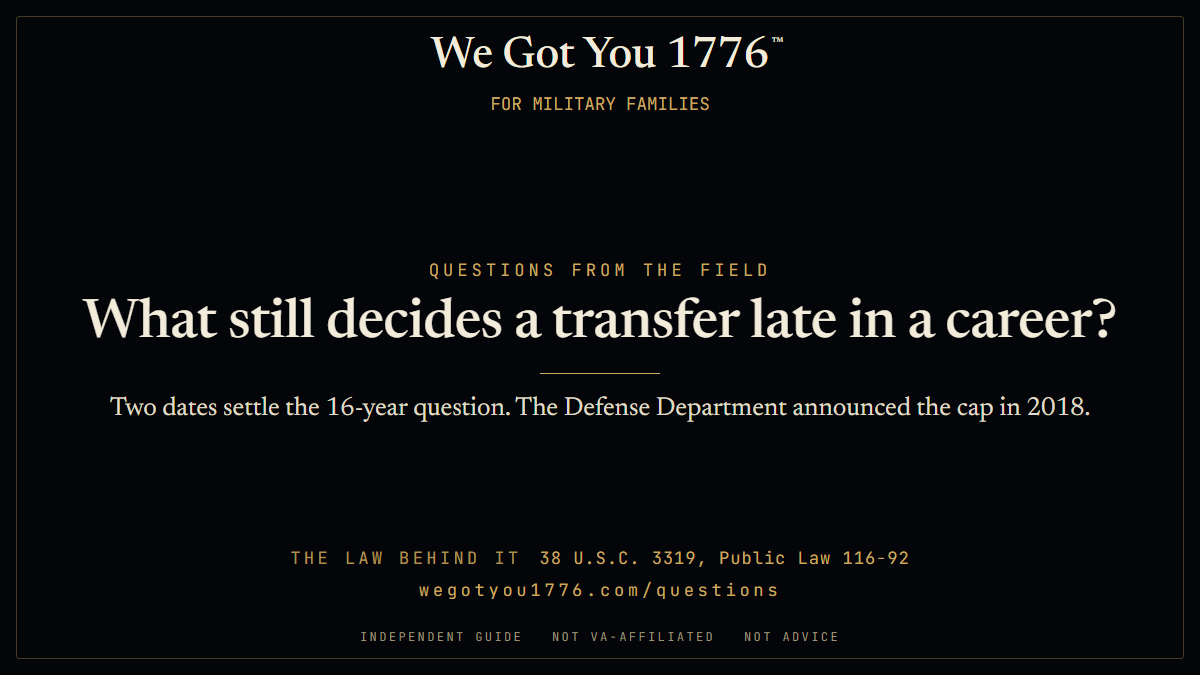
Two dates settle the 16-year question. The Defense Department announced the cap in 2018. Section 578 of the FY2020 defense act, Public Law 116-92, ended it by adding paragraph (j)(3) to 38 U.S.C. 3319, and the law has barred a maximum since December 20, 2019. A slide or a memo dated between the two describes the rule as it was announced.
What a senior member meets now is the added service. A transfer takes an agreement to serve 4 more years. Counted from the request, as DoD’s guide counts them, a member asking at 17 years serves to 21, and one asking at 24 to 28; the Navy’s manual counts from approval, and the branch sets the end date. DoD’s guide says the member has to be eligible to stay those 4 years from the request and not kept from it by policy or law. A member close to a limit on service asks about retention before asking about the transfer.
The window is the time in uniform. The request goes through milConnect while the member serves, and the member must be serving when the transfer is approved. Someone told no under the cap who is still serving can ask today. Someone who has since separated, retired or moved to the Individual Ready Reserve cannot start a transfer, and the end of the cap did not change that.
Two groups follow their own line. A Purple Heart recipient needs neither the 6 years nor the 4, and still asks while serving. A Guard or Selected Reserve member can count Selected Reserve time, active duty or both toward the 6. DoD’s guide keeps that member in the Selected Reserve without a break for the 4, DoD’s instruction asks for no break over 24 hours in active or Selected Reserve service, and the member asks the branch before moving to active duty.
The 4 years also decide a retirement date. If the member does not finish them, the family loses the transferred months, which VA’s page says it returns to the member, and what VA already paid is an overpayment the member alone owes; since January 2, 2025 the family member is not liable. VA lists exceptions, illness or injury and a reduction in force among them, and DoD’s instruction also counts certain promotion and tenure separations. Both lists are worth reading before papers are signed.
One more point reaches a senior member who still holds the Montgomery GI Bill and also qualifies for the Post-9/11 GI Bill: VA’s regulation counts the transfer request as an irrevocable choice of the second, and DoD’s guide says it cannot be reversed. VA’s page on the Rudisill and Perkins rulings says Veterans they reach can revoke an earlier choice to give up the Montgomery GI Bill, and does not mention a transfer request; VA’s education manual repeats the regulation, but one chapter processes some transfers with nothing given up, and another still has VA ask a member eligible for both kinds of Montgomery GI Bill which one is given up. VA decides. The Defense Department decides transfers, of up to 36 of the months the member has not used.
The Short. The answer as a short video, with captions and a transcript.Transcript
Asked, plainly. Is there a 16-year limit to transfer the GI Bill? Asked the way an instructor briefing education benefits asks
No: since December 20, 2019 the law has barred any maximum years of service for a GI Bill transfer, ending the 16-year cap DoD announced in 2018.
Unless the member has a Purple Heart, it still takes at least 6 years served and 4 more agreed, and DoD’s guide says the member must be eligible to be retained for those 4.
The request is made while serving, so a member who has retired or separated cannot start one.
The law behind it. 38 U.S.C. 3319, Public Law 116-92. The full answer is at wegotyou1776.com/questions
We Got You 1776. Plan around your education benefits. wegotyou1776.com/questions
The Post-9/11 education benefit: up to 36 months that pay tuition and fees to the school, a monthly housing allowance set by the campus ZIP code, and a payment for books and supplies, by the credit up to a yearly cap. How much of the tuition and housing it pays depends on how long the member served (the eligibility tier), except that a Purple Heart recipient, or someone discharged for a service-connected disability or sole survivorship after at least 30 continuous days on active duty, is paid at the 100 percent level.
Giving Post-9/11 GI Bill months to a spouse or children, the member’s dependents in DEERS. The Defense Department decides it: a member with at least 6 years of service who agrees to 4 more can transfer up to 36 of the months the member has not used, requested through milConnect while still serving. VA’s rule calls it transfer of entitlement.
From The Order Matters, The Terms, Plainly, and terms added or reworded here since, which go into the book at its next update.
How We Got You 1776 delivers the rules of VA education benefits: each rule traced to its source, each change tracked, and each check dated in public view.
Published by We Got You 1776, LLC. Also on LinkedIn.
How the We Got You 1776 site delivers and checks the rules: dated pages, one register of sources, and Questions from the Field, one question at a time.
Published by We Got You 1776, LLC.
Sources (18)
The official sources this answer is built on, the law first, then the official pages.