Asked the way a parent who already transferred asks
Can the age 26 limit on a transferred GI Bill® be extended?
Generally no: transferred GI Bill months end for a child at 26, and the law has two exceptions, for certain family caregivers and some school closings. Each is for a child kept from a program before 26: as a primary caregiver in VA’s family caregiver program, or by a closing such as one in an emergency the President declared and VA recognizes. The child asks VA, which decides: its education manual names both, its regulation stops at 26, and its extension for a disability leaves out transferred months.
If your child was kept from a program before 26 as a primary caregiver in VA’s family caregiver program, or by a closing the law covers, the child asks VA, which decides. Otherwise act before the birthday: unused months can be moved to another family member already named, or taken back, in milConnect, and a term’s months count as used from its first day. DoD’s guide takes a child of 21 or 22 only as a dependent student and says a student over 22 can no longer receive more. After you leave, the Army’s guidance says months move only among family members who already had at least 1. If you leave without retiring, ask your branch whether more months can still reach a child.
The request is yours: you ask VA (888-GIBILL-1, 888-442-4551), and VA decides. For caregiving, VA’s education manual has VA’s Family Caregivers Program determine whether you were a primary caregiver, and sends you to VA Form 10-10CG if you have not applied to it. Unless one of the law’s two exceptions fits, the months end at 26.
If another benefit is open to your child, set its own time limit beside the 26. Chapter 35 (DEA) has no time limit for a child who became eligible, turned 18 or finished high school on or after August 1, 2023; others generally use it between 18 and 26, with exceptions in the law.
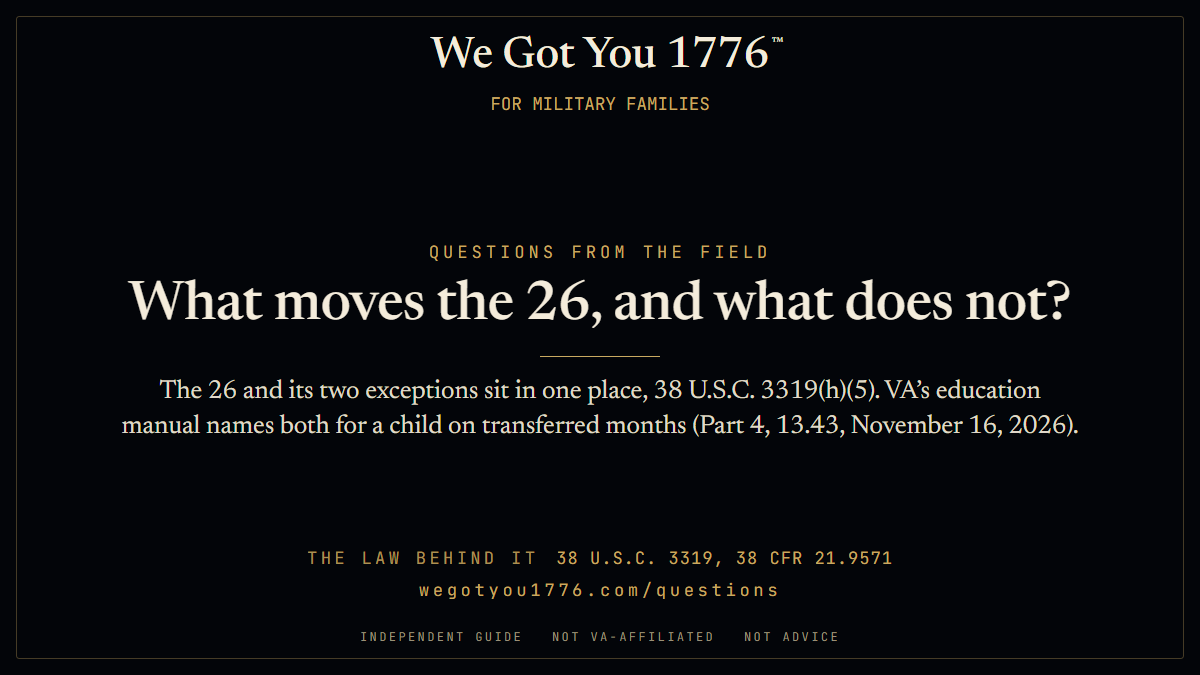
Put the law beside VA’s regulation. 38 U.S.C. 3319(h)(5) has two exceptions to 26, for some family caregivers and some school closings. VA’s education manual (Part 4, 13.43, November 16, 2026) names both for a child on transferred months. VA’s regulation carries neither: 38 CFR 21.9571 extends a child’s date only to age 26, and the disability extension in 38 CFR 21.9535 leaves out transferred months. VA decides each request.
My child was too sick for school before 26. Is there more time?
Not on transferred GI Bill months for an illness alone: the law’s two exceptions to 26 are for some family caregivers and some school closings. VA’s regulation has an extension for a disability (38 CFR 21.9535), and it leaves out transferred months. Chapter 35 (DEA), if your child qualifies for it, has age rules of its own.
My son or daughter cares for me. Can VA add time past 26?
For transferred GI Bill months VA can add time by law, when your child asks and VA finds the child was kept from a program before 26 as the primary caregiver of a Veteran or service member in VA’s family caregiver program. The time is as long as the caregiving, counted until school is reasonably feasible, and starts at 26 or later, unless the caregiving ended because VA revoked the designation. VA’s education manual has VA’s Family Caregivers Program determine who was a primary caregiver, and sends a child who has not applied to it to VA Form 10-10CG.
For transferred GI Bill months only some school closings add time past 26, and VA decides. One kind is a closing because of an emergency the President declared and VA recognizes; the other is under a policy based on an Executive order of the President. If that kept the child from a program before 26, the child gets the months VA finds were lost. VA’s education manual has steps only for closings from March 1, 2020 through December 21, 2021, so for any other the child asks VA how.
My child joined the military. Does that move the 26?
No, not for transferred GI Bill months: military service is not one of the law’s two exceptions, which are for some family caregivers and some school closings, and VA’s regulation extends a child’s date only to age 26. Chapter 35 (DEA), for a child who qualifies, differs: a child with a time limit who serves in the Armed Forces between 18 and 26 has 8 years from the first discharge, but not past age 31. Your child’s own active duty may also earn the Post-9/11 GI Bill.
The child can ask for a review, one way at a time for an issue. Within one year of the decision letter it is a Higher-Level Review of the same evidence (VA Form 20-0996) or a Board Appeal (10182); at any time, a Supplemental Claim with new and relevant evidence (20-0995). Letters in VA’s education manual give one year to keep the earliest benefit date, so ask within it. The exceptions to 26 for transferred GI Bill months are in the law, 38 U.S.C. 3319(h)(5); VA’s education manual names both for a child on transferred months, and VA’s regulation carries neither.
The 26 and its two exceptions sit in one place, 38 U.S.C. 3319(h)(5). VA’s education manual names both for a child on transferred months (Part 4, 13.43, November 16, 2026). VA’s regulation carries neither: it extends a child’s date only to age 26 (38 CFR 21.9571, in force since March 17, 2025). VA decides.
The caregiver exception takes three things: the child was the primary caregiver of a Veteran or service member in VA’s family caregiver program, that kept the child from a program, and it happened before 26. The time it gives is as long as the caregiving, counted until school is reasonably feasible, and it starts at 26 or later. A child whose caregiving ended because VA revoked the designation does not get it.
VA’s education manual says who settles the caregiving. VA’s Family Caregivers Program determines who was a primary caregiver, and a child who has not applied to that program is sent VA Form 10-10CG. The child’s request to VA for the time rests on that finding.
For the school exception, the school or training establishment has to have closed because of an emergency the President declared and VA recognizes, or under a policy based on an Executive order of the President. The closing has to have kept the child from a program before 26, and the child gets the months VA finds were lost. The manual’s steps cover closings from March 1, 2020 through December 21, 2021 only, so for any other the child asks VA how.
A child’s illness or disability, a late start and a term of military service are not among the two. The extension for a disability in VA’s regulation (38 CFR 21.9535) leaves out transferred months.
Other benefits keep their own age rules. Chapter 35 (DEA) has no time limit for a child who became eligible, turned 18 or finished high school on or after August 1, 2023. Another child with DEA generally uses it between 18 and 26, with exceptions in the law, and one who serves in the Armed Forces in those years has 8 years from the first discharge, but not past age 31.
Before the birthday the member still has a say: unused months can come back, or go to another family member already named, in milConnect. DoD’s guide takes a child of 21 or 22 only as a dependent student and says a student over 22 can no longer receive more, and after the member leaves, the Army’s guidance says only one who already had at least 1 month can. A member who leaves without retiring asks the branch whether more months can still reach a child. After a decision against the child, a review can be asked for within one year of the letter. A Supplemental Claim, which takes new and relevant evidence, can come after the year, but letters in VA’s education manual give one year to keep the earliest benefit date.
The Short. The answer as a short video, with captions and a transcript.Transcript
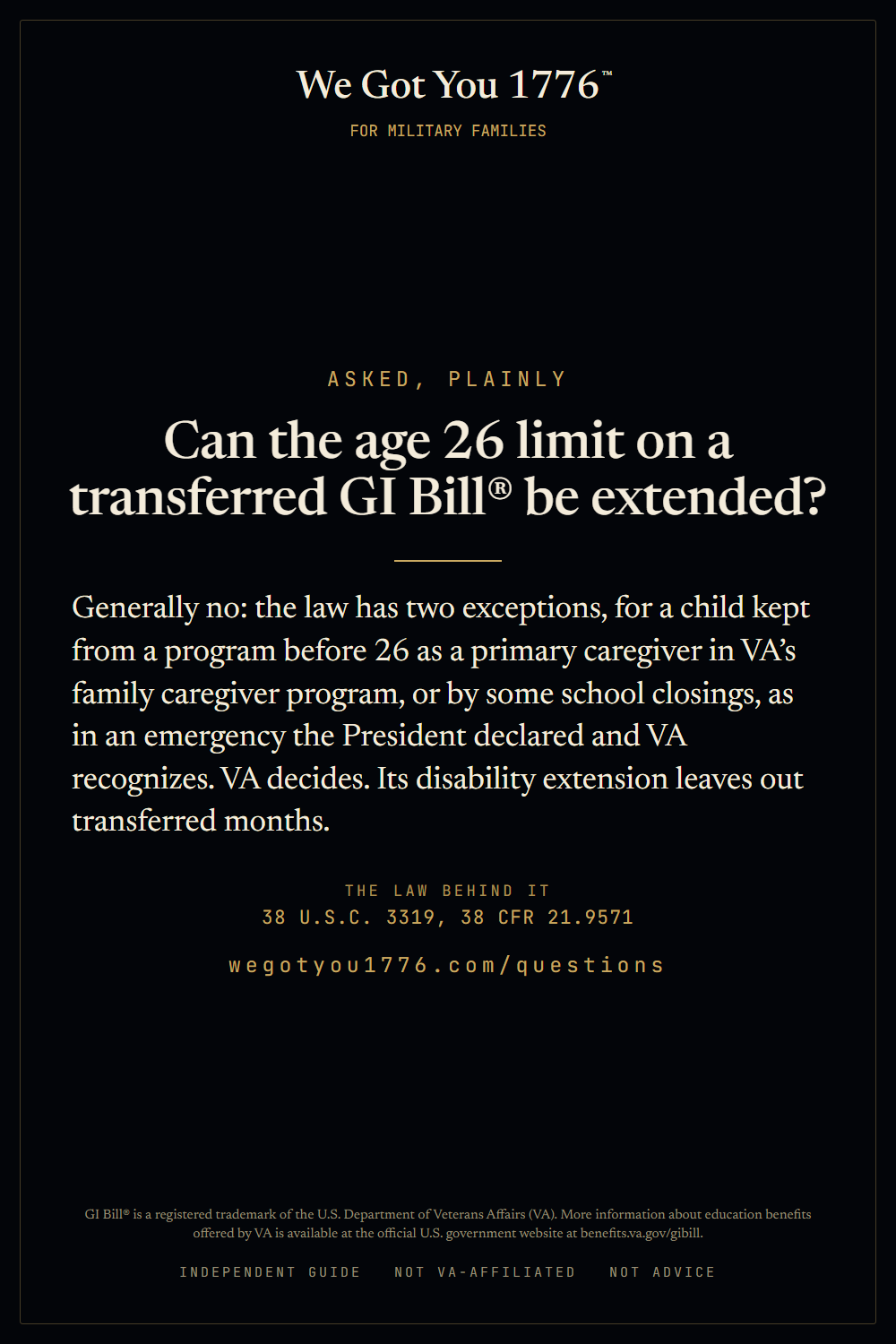
Asked, plainly. Can the age 26 limit on a transferred GI Bill be extended? Asked the way a parent who already transferred asks
Generally no: transferred GI Bill months end for a child at 26, and the law has two exceptions, for certain family caregivers and some school closings.
Each is for a child kept from a program before 26: as a primary caregiver in VA’s family caregiver program, or by a closing such as one in an emergency the President declared and VA recognizes.
The child asks VA, which decides: its education manual names both, its regulation stops at 26, and its extension for a disability leaves out transferred months.
The law behind it. 38 U.S.C. 3319, 38 CFR 21.9571. The full answer is at wegotyou1776.com/questions
We Got You 1776. Plan around your education benefits. wegotyou1776.com/questions
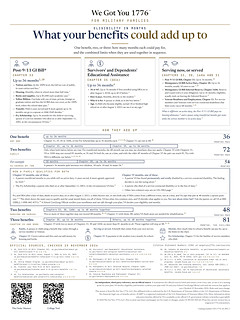
The Post-9/11 GI Bill pays up to 36 months of benefits.
It pays tuition and fees to the school, a monthly housing allowance, and up to $1,000 a year for books and supplies, $41.67 a credit for up to 24 credits.
The Post-9/11 GI Bill pays no housing allowance to a member on active duty, or to a spouse using transferred months while the member or that spouse is on active duty. For a child using transferred months the law sets the member’s active duty aside; on the child’s own, sources differ: VA’s regulation (38 CFR 21.9571) sets it aside too, while the law (38 U.S.C. 3313(j)) pays housing only for the days off active duty and VA’s rates page (October 13, 2026) says a person on active duty gets none. VA decides.
The Defense Department decides transfers. A member with at least 6 years of service who agrees to 4 more can transfer up to 36 of the months the member has not used to a spouse or children, requested through milConnect while still serving. DoD's guide says the member must be eligible to be retained for those 4 years and not kept from serving them by policy or law.
A parent can split the months among family members in any amount, and can change the split or take months back later for months not yet used. VA's regulation counts the months for a term as used from the term's first day, and VA says it awards transferred months at the start of each term, so the months for a term that has begun cannot be changed.
DEA (Chapter 35) is for the spouse or child of a Veteran VA has found permanently and totally disabled by a service-connected disability, or who died of one or in the line of duty, plus less common cases VA lists (missing, captured or detained, hospitalized). A death of any cause with that permanent and total rating in effect counts too.
DEA pays up to 36 months to a person who first enrolled in a program using DEA on or after August 1, 2018, and up to 45 to one who first enrolled using it before.
DEA pays a monthly payment directly to the student, who pays the school. It has no housing allowance or book stipend.
A child who became eligible, turned 18 or finished high school on or after August 1, 2023 can use DEA at any age with no time limit. Otherwise a child generally uses it between 18 and 26, with exceptions in the law: when VA first finds the parent permanently and totally disabled, or the parent dies, after the child turns 18 and before 26, the child has 8 years from a start date set with VA; a child who serves in the Armed Forces between 18 and 26 has 8 years from the first discharge, but not past age 31; and active duty under certain orders during the period adds that time plus four months. VA lists the other cases.
The Fry Scholarship is for the child or surviving spouse of a service member who died in the line of duty on active duty on or after September 11, 2001; of a Selected Reserve member who died on or after September 11, 2001, in the line of duty or from a service-connected disability; or, for terms that start before October 1, 2027, of a member who died from a service-connected disability within 120 days of leaving service.
Fry pays up to 36 months at the Post-9/11 GI Bill's full rate: tuition and fees, housing and books.
Yellow Ribbon is a voluntary agreement in which a school and VA share tuition and fees above what the Post-9/11 GI Bill pays. The school sets how much it pays a student a year, which can differ by student level (certificate, undergraduate, graduate, doctoral) or by college or professional school within it, and for how many students, and VA matches it. The school gives its places first come, first served to eligible students who apply the way the school sets, and keeps paying in later years while the student makes satisfactory progress and the school stays in the program. It needs the 100 percent level, and only participating schools take part.
The Montgomery GI Bill Active Duty (Chapter 30) and Selected Reserve (Chapter 1606) pay up to 36 months each, and Veteran Readiness and Employment (Chapter 31) up to 48.
VA pays one education benefit at a time. A person eligible for more than one chooses which to use, and can use them one after another.
Chapter 35 combined with other VA education programs is limited to 81 months.
A family holding 36 months of each can use both in full, one at a time: 72 months, inside the 81.
Two or more programs from a person’s own service (Chapters 30, 33 and 1606 among them) are limited to 48 months together, and by law Chapter 31 with them to 48 unless VA finds more are needed. VA’s VR&E page (November 24, 2026) says it subtracts GI Bill months used first from Chapter 31’s 48, and does not subtract Chapter 31 months from the GI Bill; an example in VA’s education manual (Part 4, 3.06, October 30, 2026) does subtract them. VA decides.
Fry with DEA: after a death in the line of duty on active duty on or after August 1, 2011, a child chooses one, or uses both only when DEA comes from a different event, which VA caps at 48 months; before that date, both, capped at 81. The law and VA’s pages state the child’s choice only for a death in the line of duty on active duty; when Fry comes from a Selected Reserve death or a death within 120 days of leaving service, VA decides how the two apply. A spouse picks one and cannot switch, apart from a choice made before December 16, 2016 when the member died from September 11, 2001 through December 31, 2005 (38 U.S.C. 3311). Only one program is used at a time. VA’s 48 sits against the 81 in 38 U.S.C. 3695(c) and 38 CFR 21.4020(c).
Housing pays only above half time. At exactly half time, 6 credits where 12 is full time, it pays nothing.
At the 100 percent level the Post-9/11 GI Bill pays the full net cost of in-state tuition and fees at a public school: what is left after any tuition waiver or reduction and any aid paid to the school only for tuition and fees.
The School Certifying Official certifies enrollment to VA and can talk through a plan. VA decides eligibility and months.
VA's education line is 888-GIBILL-1 (888-442-4551), Monday through Friday, 8:00 a.m. to 7:00 p.m. Eastern. From outside the United States, VA lists 001-918-781-5678 at the same hours; it is not toll-free.
The Montgomery GI Bill Active Duty (Chapter 30) generally must be used within 10 years of the last discharge or release from active duty, and the Montgomery GI Bill Selected Reserve (Chapter 1606) generally ends on the day the member leaves the Selected Reserve. The law and VA list exceptions.
The Post-9/11 education benefit: up to 36 months that pay tuition and fees to the school, a monthly housing allowance set by the campus ZIP code, and a payment for books and supplies, by the credit up to a yearly cap. How much of the tuition and housing it pays depends on how long the member served (the eligibility tier), except that a Purple Heart recipient, or someone discharged for a service-connected disability or sole survivorship after at least 30 continuous days on active duty, is paid at the 100 percent level.
Giving Post-9/11 GI Bill months to a spouse or children, the member’s dependents in DEERS. The Defense Department decides it: a member with at least 6 years of service who agrees to 4 more can transfer up to 36 of the months the member has not used, requested through milConnect while still serving. VA’s rule calls it transfer of entitlement.
Chapter 35 DEA (Survivors’ and Dependents’ Educational Assistance) G-03
A VA program for the spouse or child of a Veteran VA has found permanently and totally disabled by a service-connected disability, or who died of one or in the line of duty. A death of any cause with that permanent and total rating in effect counts too. DEA pays a monthly payment directly to the student, who pays the school, in steps by training time, and has no housing allowance or book stipend.
From The Order Matters, The Terms, Plainly, and terms added or reworded here since, which go into the book at its next update.
How We Got You 1776 delivers the rules of VA education benefits: each rule traced to its source, each change tracked, and each check dated in public view.
Published by We Got You 1776, LLC. Also on LinkedIn.
How the We Got You 1776 site delivers and checks the rules: dated pages, one register of sources, and Questions from the Field, one question at a time.
Published by We Got You 1776, LLC.
Sources (34)
The official sources this answer is built on, the law first, then the official pages.