Asked the way a parent who already transferred asks
If my child gets married, do they lose my GI Bill®?
No: a child’s marriage after the transfer does not affect the child’s eligibility for the GI Bill months, DoD’s instruction and VA’s education manual say. A child who is already married cannot be named in a transfer. You can still change the transfer or take back unused months, and the months generally end at 26.
A marriage after the transfer does not affect your child’s eligibility for the months, DoD’s instruction and VA’s education manual say. Any change is yours to make, in milConnect, for months not yet used; the months for a term that has begun cannot be changed.
With a son or daughter engaged and no transfer made, the order matters. A child already married cannot be named. Request the transfer while you are serving, early enough for your branch to approve it while the child is unmarried and your dependent in DEERS; it takes at least 6 years of service and 4 more agreed, or a Purple Heart.
Getting married after the months were given to you does not affect your eligibility for them, DoD’s instruction and VA’s education manual say. Your parent can still change the transfer or take back unused months. You generally use them before 26, paid at your parent’s rate.
Check each benefit by name. Transferred months: a marriage after the transfer does not affect eligibility, DoD’s instruction and VA’s manual say. Chapter 35 (DEA): a child who marries keeps it, though for a stepchild VA’s manual says marriage may end the relationship if the Veteran says they no longer provide at least half support. The added compensation VA pays a Veteran rated at least 30 percent is for an unmarried child.
Can I transfer my GI Bill to a child who is already married?
No. The law’s definition of a child (10 U.S.C. 1072) and VA’s (38 CFR 3.57), applied at the time of transfer, cover only an unmarried one. A child who marries afterward is a different case: DoD’s instruction and VA’s education manual say the marriage does not affect eligibility for GI Bill months already given.
Yes, to transfer GI Bill months, if you qualify and have not named the child yet: the child has to be unmarried at the time of transfer. Ask early enough for your branch to approve it before the wedding. The request comes while you are still serving, and the child has to be your dependent in DEERS to be given months. Once you separate, retire or move to the Individual Ready Reserve, a child cannot be added, unless a family member you already named dies.
Can I give more months to a child who has married?
Do not count on it. Giving more transferred GI Bill months takes a place in DEERS as your dependent, DoD’s guide says a student over 22 can no longer receive more, and the law’s definition of a child covers only an unmarried one. What DoD’s instruction and VA’s education manual say of a later marriage is that it does not affect eligibility for the months already transferred. Ask your branch before you plan on more.
Can my son-in-law or daughter-in-law use the months?
No. Transferred GI Bill months go to the member’s spouse, children or both, each enrolled in DEERS, and other relatives cannot receive them. A child who marries does not bring a husband or wife into the transfer, and the months stay the child’s to use, unless you change the transfer or take back the unused ones.
The same things that can end any child’s transferred GI Bill months. They generally end at 26, with two exceptions in the law, and you can take them back while unused. If you leave before finishing the added service, for a reason neither VA nor DoD lists, the family loses them and you alone owe what VA already paid. They are not paid while the Veteran is a fugitive felon.
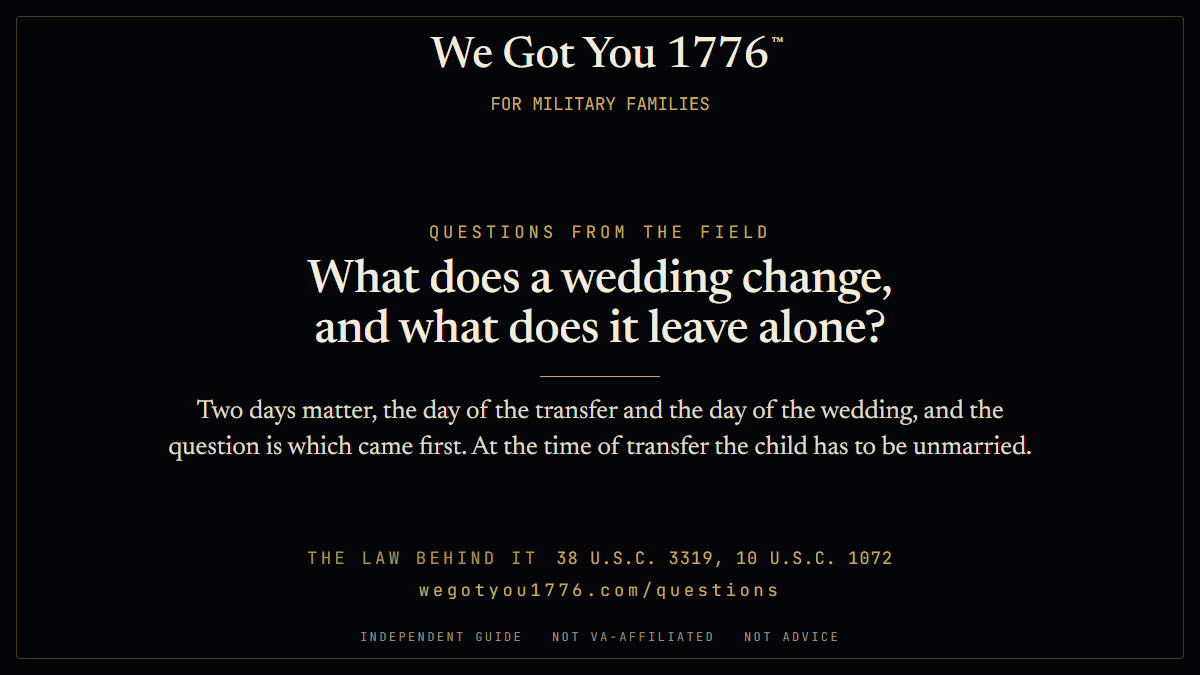
What does a wedding change, and what does it leave alone?
Two days matter, the day of the transfer and the day of the wedding, and the question is which came first. At the time of transfer the child has to be unmarried. The law’s definition of a child, 10 U.S.C. 1072, covers only an unmarried one, and so does VA’s, 38 CFR 3.57. A parent with a wedding ahead asks early enough for the branch to approve the transfer before it.
When the transfer came first, a later marriage does not affect the child’s eligibility for the months. DoD’s instruction (November 8, 2023) says it, and so do VA’s education manual, its fact sheet (March 2023) and the Navy’s manual (MILPERSMAN 1780-011, May 17, 2022). The child’s husband or wife gets nothing from the transfer, since months go to the member’s own spouse and children, each enrolled in DEERS, and other relatives cannot receive them.
The member keeps a say over months not yet used: the member can change the transfer or take them back. VA’s regulation counts a term’s months as used from its first day, so a change reaches only terms that have not begun.
Adding months is where a marriage may matter. Months can be given to a child only while the child is still the member’s dependent in DEERS, and DoD’s guide takes a child of 21 or 22 only as a dependent student and says a student over 22 can no longer receive more. A member who means to give an engaged son or daughter more than the number set today makes the change first, while the child is still a dependent there. One who leaves without retiring asks the branch whether more months can still reach a child.
The other limits hold on both sides of a wedding. The months generally end at 26, with two exceptions in the law for some family caregivers and some school closings. If the member leaves before finishing the added service, for a reason neither VA nor DoD lists, the family loses them and the member alone owes what VA already paid. They pay at the rate of the member who gave them.
Other VA money has marriage rules of its own. A child who marries keeps Chapter 35 (DEA); for a stepchild, VA’s manual adds that marriage may end the relationship if the Veteran says they no longer provide at least half support, and VA decides each case. The added disability compensation VA pays a Veteran rated at least 30 percent is for an unmarried child who is under 18, who is in an approved school from 18 until 23 and has not started DEA or the Fry Scholarship, or who became permanently incapable of self-support before 18.
The Short. The answer as a short video, with captions and a transcript.Transcript
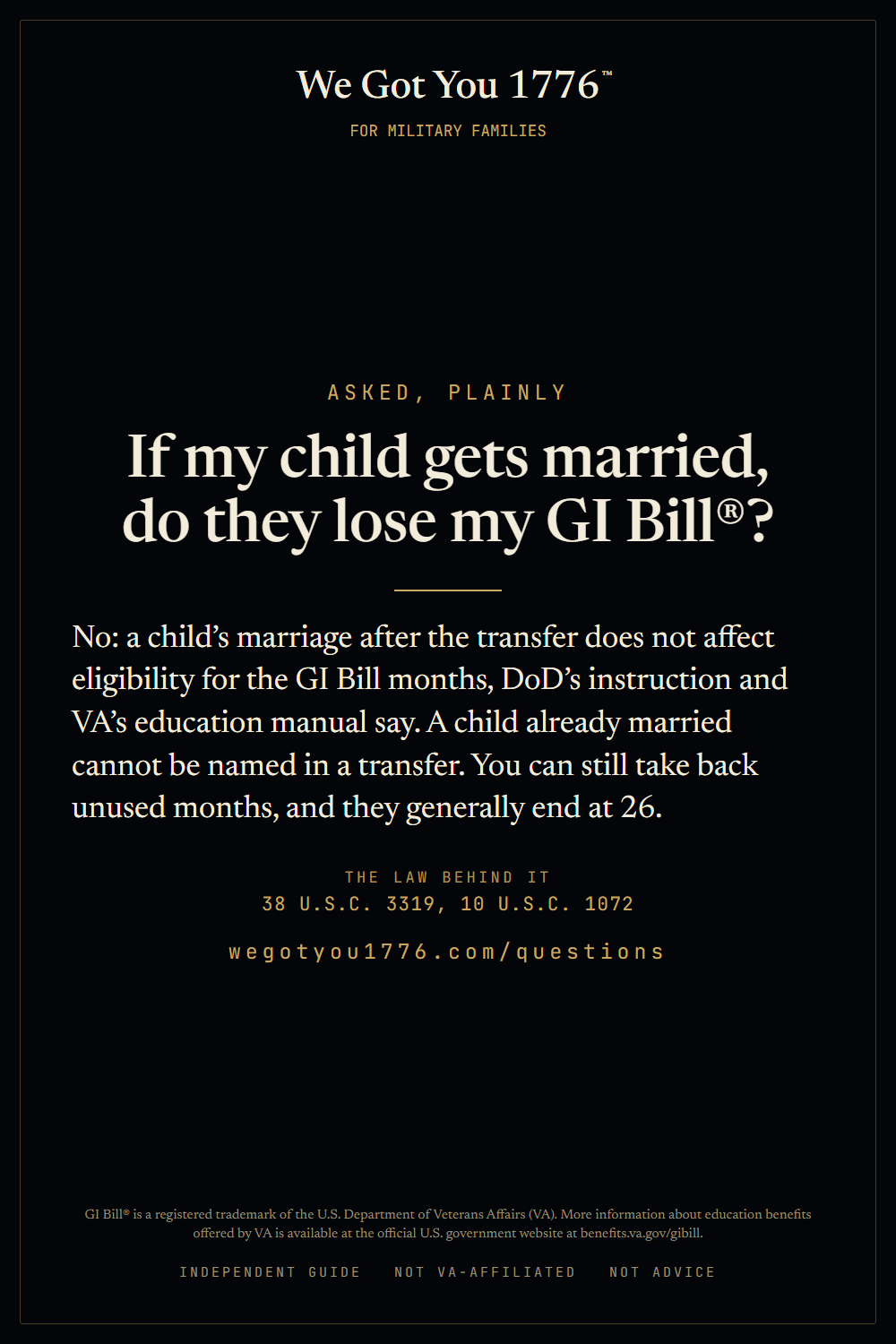
Asked, plainly. If my child gets married, do they lose my GI Bill? Asked the way a parent who already transferred asks
No: a child’s marriage after the transfer does not affect the child’s eligibility for the GI Bill months, DoD’s instruction and VA’s education manual say.
A child who is already married cannot be named in a transfer.
You can still change the transfer or take back unused months, and the months generally end at 26.
The law behind it. 38 U.S.C. 3319, 10 U.S.C. 1072. The full answer is at wegotyou1776.com/questions
We Got You 1776. Plan around your education benefits. wegotyou1776.com/questions
Giving Post-9/11 GI Bill months to a spouse or children, the member’s dependents in DEERS. The Defense Department decides it: a member with at least 6 years of service who agrees to 4 more can transfer up to 36 of the months the member has not used, requested through milConnect while still serving. VA’s rule calls it transfer of entitlement.
Chapter 35 DEA (Survivors’ and Dependents’ Educational Assistance) G-03
A VA program for the spouse or child of a Veteran VA has found permanently and totally disabled by a service-connected disability, or who died of one or in the line of duty. A death of any cause with that permanent and total rating in effect counts too. DEA pays a monthly payment directly to the student, who pays the school, in steps by training time, and has no housing allowance or book stipend.
A VA education benefit for the child or surviving spouse of a service member who died in the line of duty on active duty on or after September 11, 2001, plus the Selected Reserve and after-service cases VA lists, paid at the Post-9/11 GI Bill’s full rate.
From The Order Matters, The Terms, Plainly, and terms added or reworded here since, which go into the book at its next update.
How We Got You 1776 delivers the rules of VA education benefits: each rule traced to its source, each change tracked, and each check dated in public view.
Published by We Got You 1776, LLC. Also on LinkedIn.
How the We Got You 1776 site delivers and checks the rules: dated pages, one register of sources, and Questions from the Field, one question at a time.
Published by We Got You 1776, LLC.
Sources (39)
The official sources this answer is built on, the law first, then the official pages.