Asked the way a service member doing four years and getting out asks
How many credits do I need to get GI Bill® housing?
Post-9/11 GI Bill housing takes at least 7 undergraduate credits in a regular term where the school certifies 12 or 13 as full time, or 8 where full time is 14. For graduate courses it takes more than half of the full time the school certifies, or of 14. VA’s handbook says only courses that meet a requirement of your program can be certified, apart from a needed remedial course in person and rounding out a last term. A member on active duty, or a spouse on transferred months while the member or that spouse is on active duty, gets none at any load.
How many credits to take depends on your situation, including what your school counts as full time, your work and family hours, how far your months need to stretch, and what your degree still needs. Only you can weigh it for your family.
The housing allowance, school by school, phase by phase.
College Tool sets each phase’s housing allowance from the school’s location and shows the months it does not pay, with the savings to carry the student through them.
5.0 on the App Store. Free to start. A one-time purchase unlocks the full phase approach.
While you are on active duty the Post-9/11 GI Bill pays no housing allowance, whatever your credits. Once you are out, ask the school which number it certifies as full time for undergraduates: 7 credits is the least that pays housing in a regular term where it is 12 or 13, and 8 where it is 14.
Check each class against what your degree requires before you count credits. Say you take 9 and 3 of them are an elective your program has no place for. Outside a last term’s rounding out, VA’s handbook says that course cannot be certified, so 6 credits are, and where 12 is full time 6 is exactly half and pays no housing.
For undergraduates full time is 12 or 13 credits where the school certifies it, or 14; for graduate courses it is what the school certifies, or 14. For a student above half time in a final term starting on or after January 1, 2025, the certifying official marks the last term on the enrollment certification, only once for a program at a school. VA decides whether the full housing for the student’s eligibility tier is paid.
A family on Chapter 35 (DEA) has no housing allowance to plan on at any load. DEA pays a monthly payment directly to the student, in steps by training time, and below half time it covers tuition and fees only, up to a cap.
the credits the school certifies for you ÷ the credits it counts as full time
Where 12 is full time
6 ÷ 12 is exactly half, and housing pays nothing; 7 ÷ 12 is 58 percent, paid at 60
Where 13 is full time
6 ÷ 13 is 46 percent, and housing pays nothing; 7 ÷ 13 is 54 percent, paid at 50
Where 14 is full time
7 ÷ 14 is exactly half, and housing pays nothing; 8 ÷ 14 is 57 percent, paid at 60
Graduate courses where 9 is full time
4 ÷ 9 is 44 percent, and housing pays nothing; 5 ÷ 9 is 56 percent, paid at 60
What the percent is taken of
the housing for your eligibility tier (none for a member on active duty, or for a spouse on transferred months while the member or that spouse is); in a final term the school marks, above half time, for terms starting on or after January 1, 2025, VA can pay it in full
A summer or other short session of undergraduate credits
the credits × 18, or the quarter hours × 12, ÷ the weeks in the session (breaks of 7 days or more left out, 4 or more leftover days counted as a week), then ÷ the credits your school counts as full time
I’m one credit short. Can I add an elective to get BAH?
Only if it meets a requirement of your program. VA’s School Certifying Official Handbook says a course that does not, excess electives among them, cannot be certified, and neither can an audited course. In the last term a course outside the program counts only when you take all the courses the program offers that term, or it offers none.
Is 7 credits enough for BAH where 13 is full time?
Yes, for undergraduates in a regular term: 7 of 13 is above half time, and housing is paid at 50 percent, before your eligibility tier. In a final term the school marks, starting on or after January 1, 2025, VA can pay the full housing for your tier. A member on active duty, or a spouse using transferred months while the member or that spouse is, gets none.
In person they can: an in-person remedial or deficiency course can be certified for a student with a documented need. VA does not pay for remedial or deficiency courses taken online, and VA’s School Certifying Official Handbook says the same of a hybrid format. A member on active duty, or a spouse using transferred months while the member or that spouse is, gets no GI Bill housing.
How many graduate credits do I need for GI Bill BAH?
More than half of the full time your school certifies for graduate courses, or of 14. Where it certifies 9 in a regular term, 4 credits is under half and pays no housing, and 5 is above half and pays 60 percent of the housing for your eligibility tier, outside a final term the school marks. A member on active duty, or a spouse using transferred months while the member or that spouse is, gets none.
Do I need more credits for BAH if my classes are online?
No. Housing pays only above half time either way, at your eligibility tier and, outside a final term the school marks, your rate of pursuit. The figure is different: all-online study pays half the national average housing allowance, and one in-person class keeps the local rate. A member on active duty, or a spouse using transferred months while the member or that spouse is, gets none, online or in person.
The line is a rate of pursuit above 50 percent, and one credit can decide it. At a school that certifies 12 as full time for its undergraduates, 6 credits is exactly half and 7 is over. At 13, 6 credits is 46 percent and 7 is 54. At 14, the number VA uses when a school certifies neither, 7 is exactly half and 8 is over. The same 7 credits can pay housing at one school and none at the next.
Rounding sets the amount, and the line comes first. A rate of 54 percent, 7 of 13, is above half and is paid at 50 percent. Seven of 12 and 8 of 14 are each paid at 60. Those percentages come before the eligibility tier, so a student below the 100 percent tier is paid that share of a smaller figure.
What goes into the count matters as much. VA’s School Certifying Official Handbook says a school can certify only courses that meet a requirement of the student’s program. Excess electives cannot be certified, and neither can an audited course. Before the last term, a student with 6 credits the degree needs and a 3-credit elective it does not is enrolled in 9 and certified for 6, which where 12 is full time pays no housing.
Two kinds of course have a rule of their own. An in-person remedial or deficiency course can be certified for a student with a documented need, and VA does not pay for one taken online; the handbook says the same of a hybrid format. In the last term, a course outside the program counts only when all the courses the program offers that term are taken or none is offered. For terms starting on or after January 1, 2025, when the school marks the term as the last and the student is above half time, VA can also pay the full housing for the student’s tier.
Graduate courses go by the full time the school certifies for them, or 14, so in a regular term where the school certifies 9 the least that pays housing is 5 credits. A program measured in clock hours goes by the clock hours scheduled each week. Undergraduate credits in a summer or other short session are measured by the session’s length, so fewer of them can be over the line. For a graduate program, VA says it pays based on the rate of pursuit the school reports.
Two answers from the school come first, before registration: the number it certifies as full time for the program, and which of the classes meet a requirement. The school’s certifying official certifies the enrollment to VA and can talk through a plan. No load brings GI Bill housing to a member on active duty, or to a spouse using transferred months while the member or that spouse is; a child using transferred months may get it even while the parent is.
The Short. The answer as a short video, with captions and a transcript.Transcript
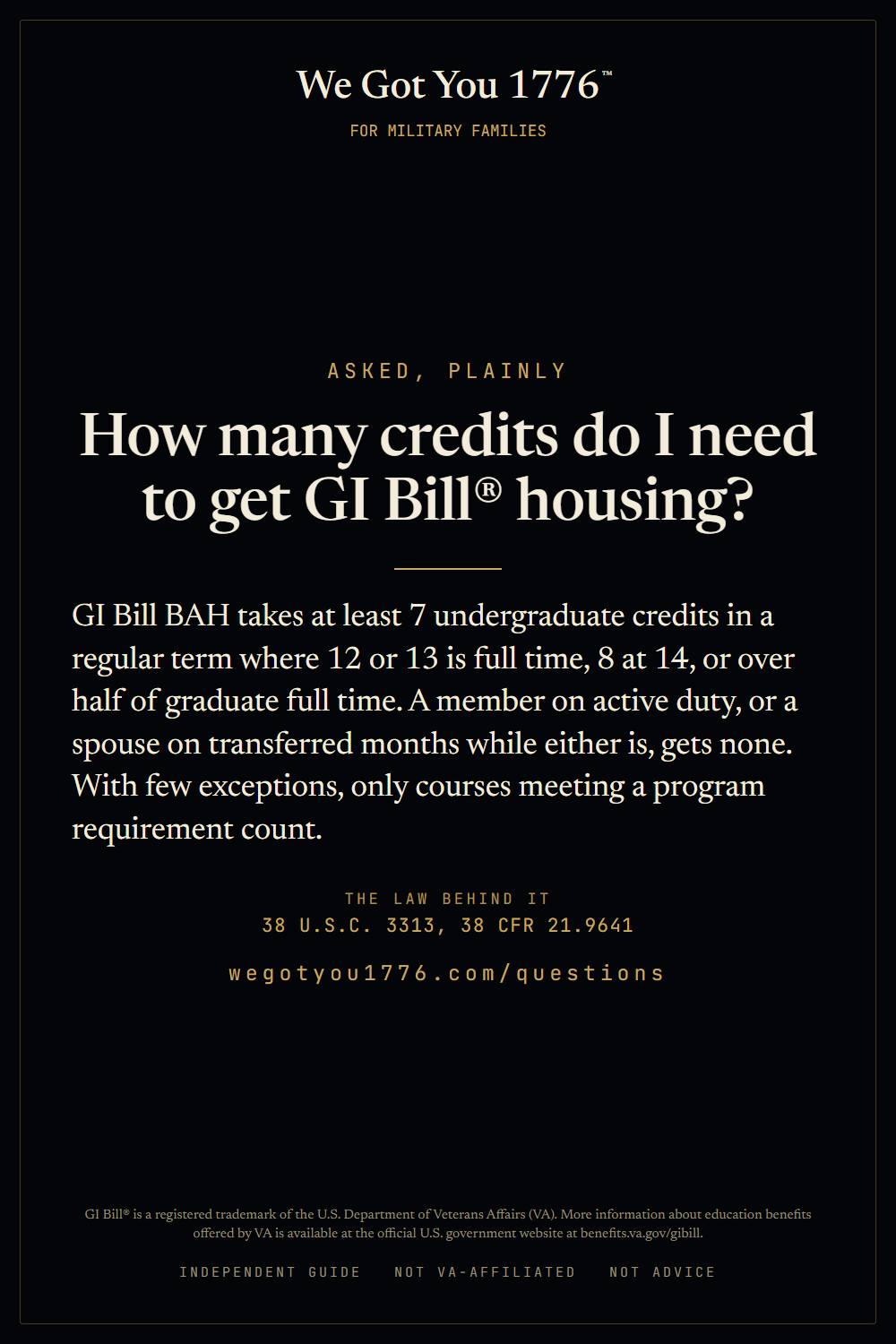
Asked, plainly. How many credits do I need to get GI Bill housing? Asked the way a service member doing four years and getting out asks
Post-9/11 GI Bill housing takes at least 7 undergraduate credits in a regular term where the school certifies 12 or 13 as full time, or 8 where full time is 14.
For graduate courses it takes more than half of the full time the school certifies, or of 14.
VA’s handbook says only courses that meet a requirement of your program can be certified, apart from a needed remedial course in person and rounding out a last term.
A member on active duty, or a spouse on transferred months while the member or that spouse is on active duty, gets none at any load.
The law behind it. 38 U.S.C. 3313, 38 CFR 21.9641. The full answer is at wegotyou1776.com/questions
We Got You 1776. Plan around your education benefits. wegotyou1776.com/questions
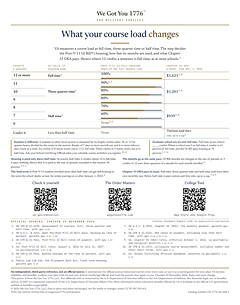
Post-9/11 GI Bill housing share of the full monthly rate
Chapter 35 DEA a month, from Oct. 1, 2026
12 or more
Full time
100%
$1,621
11
Three-quarter time
90%
$1,281
10
80%
9
80%
8
Half time
70%
$939
7
60%
6
None
Under 6
Less than half time
None
Tuition and feesonly, up to a cap
Summer is different. A summer or other short session is measured by its length: credits times 18, or 12 for quarter hours, divided by the weeks in the session. Breaks of 7 days or more are left out, and 4 or more leftover days count as a week. Six credits in 8 weeks works out to 13.5: full time. Three credits in 9 weeks works out to 6: half time. Ask your School Certifying Official what your schedule counts as before you register.
Graduate school sets its own full time. Full time at our school: ______ credits. Where a school sets 9 as full time, 6 credits is 67 percent of full time, and the GI Bill pays housing at 70 percent.
From October 1, 2026, DEA pays $1,621 a month full time, $1,281 at three-quarter time and $939 at half time.
DEA pays in steps by training time: where the school certifies 12 credits as full time, 9 to 11 is three-quarter and 6 to 8 half. Below half time the monthly payment covers tuition and fees only, up to a cap.
Housing pays only above half time. At exactly half time, 6 credits where 12 is full time, it pays nothing.
Above half time, housing is paid at the rate of pursuit rounded to the nearest 10 percent: 7 credits of 12 is 60 percent, 8 is 70, 9 or 10 is 80, 11 is 90.
A summer or other short session of undergraduate credits is measured by its length: credits times 18, or 12 for quarter hours, divided by the weeks in the session; breaks of 7 days or more are left out, and 4 or more leftover days count as a week. For a graduate program, VA’s regulation goes by what the school certifies where it counts fewer than 14 credits as full time or the course includes research, thesis or similar work, and VA says it pays based on the rate of pursuit or training time the school reports.
GI Bill months are charged at the rate of pursuit, so 9 credits of 12 uses three-quarters of a month for each month enrolled.
In the final term, a Post-9/11 student enrolled more than half time gets the full housing allowance, for terms starting on or after January 1, 2025. The certifying official marks the term as the student's last term on the enrollment certification, and VA decides whether the full housing is paid; a last term can be marked only once for a program at a school.
The Post-9/11 education benefit: up to 36 months that pay tuition and fees to the school, a monthly housing allowance set by the campus ZIP code, and a payment for books and supplies, by the credit up to a yearly cap. How much of the tuition and housing it pays depends on how long the member served (the eligibility tier), except that a Purple Heart recipient, or someone discharged for a service-connected disability or sole survivorship after at least 30 continuous days on active duty, is paid at the 100 percent level.
Giving Post-9/11 GI Bill months to a spouse or children, the member’s dependents in DEERS. The Defense Department decides it: a member with at least 6 years of service who agrees to 4 more can transfer up to 36 of the months the member has not used, requested through milConnect while still serving. VA’s rule calls it transfer of entitlement.
Chapter 35 DEA (Survivors’ and Dependents’ Educational Assistance) G-03
A VA program for the spouse or child of a Veteran VA has found permanently and totally disabled by a service-connected disability, or who died of one or in the line of duty. A death of any cause with that permanent and total rating in effect counts too. DEA pays a monthly payment directly to the student, who pays the school, in steps by training time, and has no housing allowance or book stipend.
The GI Bill’s monthly housing payment: DoD’s Basic Allowance for Housing for an E-5 with dependents at the ZIP code of the campus where the student attends most classes. Schools abroad use one foreign rate instead, and a U.S. school’s campus abroad may not get the home campus rate.
How much of a full load you are carrying, as a percentage. Nine credits where 12 is full time is 75 percent. The GI Bill pays housing by it, rounded to the nearest 10 percent, and only when it is over 50 percent. It also sets how fast your GI Bill months get used. DEA uses steps instead: full, three-quarter, half, and less than half.
How VA measures a course load. VA counts 14 credits a term as full time unless the school certifies 12 or 13 for its undergraduates. Where 12 is full time, 9 to 11 is three-quarter time and 6 to 8 is half time; for graduate work, full time is what the school certifies, or 14 credits. Chapter 35 DEA pays in steps by it, and the GI Bill pays housing only above half time.
How We Got You 1776 delivers the rules of VA education benefits: each rule traced to its source, each change tracked, and each check dated in public view.
Published by We Got You 1776, LLC. Also on LinkedIn.
How the We Got You 1776 site delivers and checks the rules: dated pages, one register of sources, and Questions from the Field, one question at a time.
College Tool turns The Order Matters’ phase approach into a family’s plan, with each school’s housing rate, the math shown and its official sources linked.
Published by We Got You 1776, LLC. Also on LinkedIn.
Sources (28)
The official sources this answer is built on, the law first, then the official pages.