Asked the way a parent thinking about transferring asks
Can I transfer my GI Bill® to a spouse who also serves?
Yes, if you qualify and ask while serving: the law lets a member transfer Post-9/11 GI Bill months to a spouse in DEERS and makes no exception for one who serves. Your spouse is paid no housing allowance on transferred months while either of you is on active duty. You need at least 6 years of service and 4 more agreed, or a Purple Heart, and the Defense Department decides.
Whether to give months to a spouse who serves depends on your situation, including the months your spouse earns from that service, who will be on active duty during school, your children’s ages and plans, and how long each of you will serve. Only you can weigh it for your family.
What to watchVA’s regulation and VA’s education manual say different things about a person who has both transferred months and Post-9/11 months from the person’s own service.
The person is paid on one of them at a time, says which in writing, and a change starts with the next enrollment period unless one runs out during a term. The 48-month limit applies only when the person is also awarded the Montgomery GI Bill or another program that limit covers.
What to watchOfficial sources say different things about the books and supplies stipend for a spouse using transferred months while the member is on active duty.
The Navy’s manual says a spouse who serves may also qualify for the Post-9/11 GI Bill. On that spouse’s own months beside yours, VA’s regulation pays one of them at a time, its education manual says both can be paid concurrently, and VA decides. Months your spouse has not used can be taken back or, while you serve, moved to a child who is your dependent in DEERS; once you leave, only to one already named, and the Army’s guidance says one who already had at least 1 month. DoD’s guide says a student over 22 can no longer receive more. If you leave without retiring, ask your branch whether more months can still reach a child.
If you are out and your spouse still serves, your spouse can use months you gave, unless you left before finishing the added service for a reason neither VA nor DoD lists. If you separated from active duty before January 1, 2013, your spouse has 15 years from it; on or after, there is no limit. Your spouse is paid no housing on them while your spouse is on active duty. A spouse you never named cannot be added now, unless a family member you named dies.
Two members can mean two sets of months for one child. The Navy’s manual has the child enrolled in DEERS under both, and by law the child uses one member’s months at a time. Housing on a child’s transferred months may be paid even while a parent is on active duty.
For dual-military couples, put three lines up. The law makes no exception to a transfer for a spouse who serves. No GI Bill housing is paid to a member on active duty, or to a spouse on transferred months while the member or that spouse is on active duty. On paying a spouse’s own Post-9/11 months and the transferred ones concurrently, VA’s regulation (March 17, 2025) and its education manual (December 18, 2015) differ, and VA decides.
We both serve. Can we each give months to our child?
Yes, if each of you qualifies: the Navy’s manual says two members can each transfer to their child, enrolled in DEERS under both. Each member needs at least 6 years of service and 4 more agreed, or a Purple Heart, and asks while serving. By law the child uses one member’s months at a time.
Is there GI Bill housing while we are both active duty?
Not for either of you: the Post-9/11 GI Bill pays no housing allowance to a member on active duty, or to a spouse using transferred months while the member or that spouse is on active duty. A child using transferred months may get it even while a parent is on active duty.
My wife or husband gave me months. Do they count in my 48?
With only Post-9/11 months of your own, no: VA’s regulation applies the 48-month limit only when you are also awarded the Montgomery GI Bill or another program that limit covers. VA’s education manual does not count transferred months toward the family member’s 48. With another program of your own the two differ, and VA decides.
Can one spouse use both sets of months in the same term?
VA’s own sources differ. Its regulation (38 CFR 21.9691, in force since March 17, 2025) pays a person with transferred months and Post-9/11 months from the person’s own service on one of them at a time, named in writing. A change starts with the next enrollment period unless one runs out during the term. Its education manual (a part of December 18, 2015) says both can be paid concurrently. VA decides, so ask before the term: 888-GIBILL-1 (888-442-4551).
The member who transfers the months; if both of you transfer, each of you agrees to 4 more. If that member leaves before they are done, for a reason neither VA nor DoD lists, the family loses the months that member gave, and what VA already paid is an overpayment that member alone owes. A member who transfers as a Purple Heart recipient has no added service.
A couple in which both serve has two service records, and each record can open its own transfer. The law lets a member transfer months to a spouse and makes no exception for one who serves. The Navy’s manual (MILPERSMAN 1780-011, May 17, 2022) adds that the spouse may also qualify for the Post-9/11 GI Bill, so one person can end up with months from two records.
The member giving the months is the one who qualifies: 6 years of service and 4 more agreed, or a Purple Heart, asked for in milConnect while serving, with the spouse enrolled in DEERS. If each gives months to the other there are two requests, and each member not transferring as a Purple Heart recipient agrees to 4 more years. One who leaves before finishing them, for a reason neither VA nor DoD lists, costs the family the months that member gave.
Active duty decides the housing, and here it counts twice. A spouse using the months is paid none while the member who gave them is on active duty, and none while that spouse is. Once neither is on active duty, housing follows the usual rules: above half time, by the campus where the student attends most classes, with separate rates outside the U.S. and for all-online study. On the books stipend for a spouse while the member who gave the months is on active duty, official sources differ, and VA decides the payment.
When a spouse holds transferred months and Post-9/11 months from that spouse’s own service, VA’s own sources differ. Its regulation, 38 CFR 21.9691, in force since March 17, 2025, pays one of them at a time, named in writing, and a change starts with the next enrollment period unless one runs out during the term. Its education manual (Part 12, Chapter 2, 4.01 and 4.05, December 18, 2015) says both can be paid concurrently. A spouse planning a term on both asks VA first.
The 48-month count has two versions as well. VA’s regulation (38 CFR 21.9571) brings the limit in only when the spouse is also awarded the Montgomery GI Bill or another program that limit covers. The manual does not count transferred months toward the family member’s 48. VA decides.
A child can hold months from both parents, enrolled in DEERS under both, the Navy’s manual says. By law the child uses one member’s months at a time, and the housing on them may be paid even while a parent is on active duty. The months generally end at 26, with two exceptions in the law.
When one leaves first, only that member’s list of names closes. The member who has separated, retired or moved to the Individual Ready Reserve can add nobody, unless a family member already named dies. The one still serving can still ask, with 6 years in and 4 more agreed or a Purple Heart.
The Short. The answer as a short video, with captions and a transcript.Transcript
Asked, plainly. Can I transfer my GI Bill to a spouse who also serves? Asked the way a parent thinking about transferring asks
Yes, if you qualify and ask while serving: the law lets a member transfer Post-9/11 GI Bill months to a spouse in DEERS and makes no exception for one who serves.
Your spouse is paid no housing allowance on transferred months while either of you is on active duty.
You need at least 6 years of service and 4 more agreed, or a Purple Heart, and the Defense Department decides.
The law behind it. 38 U.S.C. 3319, 38 CFR 21.9691. The full answer is at wegotyou1776.com/questions
We Got You 1776. Plan around your education benefits. wegotyou1776.com/questions
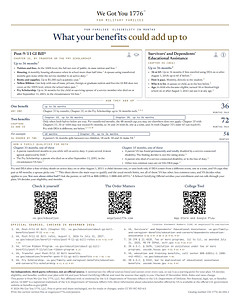
The Post-9/11 GI Bill pays up to 36 months of benefits.
It pays tuition and fees to the school, a monthly housing allowance, and up to $1,000 a year for books and supplies, $41.67 a credit for up to 24 credits.
The Post-9/11 GI Bill pays no housing allowance to a member on active duty, or to a spouse using transferred months while the member or that spouse is on active duty. For a child using transferred months the law sets the member’s active duty aside; on the child’s own, sources differ: VA’s regulation (38 CFR 21.9571) sets it aside too, while the law (38 U.S.C. 3313(j)) pays housing only for the days off active duty and VA’s rates page (October 13, 2026) says a person on active duty gets none. VA decides.
The Defense Department decides transfers. A member with at least 6 years of service who agrees to 4 more can transfer up to 36 of the months the member has not used to a spouse or children, requested through milConnect while still serving. DoD's guide says the member must be eligible to be retained for those 4 years and not kept from serving them by policy or law.
A parent can split the months among family members in any amount, and can change the split or take months back later for months not yet used. VA's regulation counts the months for a term as used from the term's first day, and VA says it awards transferred months at the start of each term, so the months for a term that has begun cannot be changed.
DEA (Chapter 35) is for the spouse or child of a Veteran VA has found permanently and totally disabled by a service-connected disability, or who died of one or in the line of duty, plus less common cases VA lists (missing, captured or detained, hospitalized). A death of any cause with that permanent and total rating in effect counts too.
DEA pays up to 36 months to a person who first enrolled in a program using DEA on or after August 1, 2018, and up to 45 to one who first enrolled using it before.
DEA pays a monthly payment directly to the student, who pays the school. It has no housing allowance or book stipend.
A child who became eligible, turned 18 or finished high school on or after August 1, 2023 can use DEA at any age with no time limit. Otherwise a child generally uses it between 18 and 26, with exceptions in the law: when VA first finds the parent permanently and totally disabled, or the parent dies, after the child turns 18 and before 26, the child has 8 years from a start date set with VA; a child who serves in the Armed Forces between 18 and 26 has 8 years from the first discharge, but not past age 31; and active duty under certain orders during the period adds that time plus four months. VA lists the other cases.
The Fry Scholarship is for the child or surviving spouse of a service member who died in the line of duty on active duty on or after September 11, 2001; of a Selected Reserve member who died on or after September 11, 2001, in the line of duty or from a service-connected disability; or, for terms that start before October 1, 2027, of a member who died from a service-connected disability within 120 days of leaving service.
Fry pays up to 36 months at the Post-9/11 GI Bill's full rate: tuition and fees, housing and books.
Yellow Ribbon is a voluntary agreement in which a school and VA share tuition and fees above what the Post-9/11 GI Bill pays. The school sets how much it pays a student a year, which can differ by student level (certificate, undergraduate, graduate, doctoral) or by college or professional school within it, and for how many students, and VA matches it. The school gives its places first come, first served to eligible students who apply the way the school sets, and keeps paying in later years while the student makes satisfactory progress and the school stays in the program. It needs the 100 percent level, and only participating schools take part.
VA pays one education benefit at a time. A person eligible for more than one chooses which to use, and can use them one after another.
Chapter 35 combined with other VA education programs is limited to 81 months.
A family holding 36 months of each can use both in full, one at a time: 72 months, inside the 81.
Fry with DEA: after a death in the line of duty on active duty on or after August 1, 2011, a child chooses one, or uses both only when DEA comes from a different event, which VA caps at 48 months; before that date, both, capped at 81. The law and VA’s pages state the child’s choice only for a death in the line of duty on active duty; when Fry comes from a Selected Reserve death or a death within 120 days of leaving service, VA decides how the two apply. A spouse picks one and cannot switch, apart from a choice made before December 16, 2016 when the member died from September 11, 2001 through December 31, 2005 (38 U.S.C. 3311). Only one program is used at a time. VA’s 48 sits against the 81 in 38 U.S.C. 3695(c) and 38 CFR 21.4020(c).
Housing pays only above half time. At exactly half time, 6 credits where 12 is full time, it pays nothing.
At the 100 percent level the Post-9/11 GI Bill pays the full net cost of in-state tuition and fees at a public school: what is left after any tuition waiver or reduction and any aid paid to the school only for tuition and fees.
The School Certifying Official certifies enrollment to VA and can talk through a plan. VA decides eligibility and months.
VA's education line is 888-GIBILL-1 (888-442-4551), Monday through Friday, 8:00 a.m. to 7:00 p.m. Eastern. From outside the United States, VA lists 001-918-781-5678 at the same hours; it is not toll-free.
The Post-9/11 education benefit: up to 36 months that pay tuition and fees to the school, a monthly housing allowance set by the campus ZIP code, and a payment for books and supplies, by the credit up to a yearly cap. How much of the tuition and housing it pays depends on how long the member served (the eligibility tier), except that a Purple Heart recipient, or someone discharged for a service-connected disability or sole survivorship after at least 30 continuous days on active duty, is paid at the 100 percent level.
Giving Post-9/11 GI Bill months to a spouse or children, the member’s dependents in DEERS. The Defense Department decides it: a member with at least 6 years of service who agrees to 4 more can transfer up to 36 of the months the member has not used, requested through milConnect while still serving. VA’s rule calls it transfer of entitlement.
The GI Bill’s monthly housing payment: DoD’s Basic Allowance for Housing for an E-5 with dependents at the ZIP code of the campus where the student attends most classes. Schools abroad use one foreign rate instead, and a U.S. school’s campus abroad may not get the home campus rate.
How VA measures a course load. VA counts 14 credits a term as full time unless the school certifies 12 or 13 for its undergraduates. Where 12 is full time, 9 to 11 is three-quarter time and 6 to 8 is half time; for graduate work, full time is what the school certifies, or 14 credits. Chapter 35 DEA pays in steps by it, and the GI Bill pays housing only above half time.
From The Order Matters, The Terms, Plainly, and terms added or reworded here since, which go into the book at its next update.
How We Got You 1776 delivers the rules of VA education benefits: each rule traced to its source, each change tracked, and each check dated in public view.
Published by We Got You 1776, LLC. Also on LinkedIn.
How the We Got You 1776 site delivers and checks the rules: dated pages, one register of sources, and Questions from the Field, one question at a time.
Published by We Got You 1776, LLC.
Sources (31)
The official sources this answer is built on, the law first, then the official pages.