Asked the way a service member doing four years and getting out asks
How long does it take the GI Bill® to kick in?
The GI Bill kicks in after three steps: VA averages 30 days on the application, the school certifies you, and Post-9/11 housing is paid after each month in school. The certifying official can report a Post-9/11 student as early as 180 days before the term and has until 30 days after it begins, or 30 days after getting your certificate where the school requires proof. Chapter 35 (DEA) pays the student after each month is verified. A member on active duty, or a spouse on that member’s transferred months, gets no housing.
How much you need set aside before the first payment depends on your situation, including when you apply, the day the term starts, when the school certifies you, the load you carry and whether you are on active duty. Only you can weigh it for your family.
Print it, sources and all.
College Tool prints the plan for the family’s records and review: each phase, its benefit and months, and the official reference behind each number.
5.0 on the App Store. Free to start. A one-time purchase unlocks the full phase approach.
VA takes an application from a service member, so the 30-day average can run before you are out. Post-9/11 housing is not paid to a member on active duty. Once you are off it, housing is paid above half time, after each month in school.
A child or spouse on DEA is paid by the month, after the month is verified, and pays the school, so a tuition bill due at the start of the term comes ahead of the first payment. DEA has no housing allowance.
Your last date is 30 days after the term begins, or after you receive the Certificate of Eligibility where the school requires proof of eligibility. VA’s handbook has each term certified on its own, as early as 180 days before it for a Post-9/11 student and 120 for the Montgomery GI Bill and DEA. The law lets a school certify more than one at a time, but not past the end of the school year and its summer, and not for a student on active duty or under half time.
Two questions show where the wait is: has VA sent the Certificate of Eligibility, and has the school certified this term. The Veteran asks the first of VA’s education line, 888-GIBILL-1 (888-442-4551), since VA shares a person’s records with that person or someone they authorized; the second is for the school’s certifying official.
First the school’s certifying official certifies the enrollment, by 30 days after the term begins, or 30 days after receiving your Certificate of Eligibility where the school requires proof. Post-9/11 housing then comes after each month in school, for the days enrolled. A member on active duty, or a spouse on that member’s transferred months, gets none.
My school has not certified me yet. How long do I wait?
Up to 30 days after the term begins, or 30 days after the school received your Certificate of Eligibility where it requires proof of eligibility. VA’s handbook lets it report as early as 180 days before the term for a Post-9/11 student and 120 for the Montgomery GI Bill and DEA. Certifying is the official’s step, so ask that office whether your enrollment has gone to VA. VA then sends you an award letter, which needs no action.
I get out in May and start school in August. When do I apply?
You can apply while you are still serving, online at VA.gov or by mail with VA Form 22-1990. VA averages 30 days, so an application in by June has that average behind it before an August term. The Certificate of Eligibility VA sends is what you give the school’s certifying official.
With no change of program or school, there is no application in it: VA’s regulation lists none for each term, apart from a member’s Tuition Assistance Top-Up, claimed by the course. The wait starts with the school, which certifies the new term no later than 30 days after it begins. Post-9/11 housing, for a student paid it, then comes after each month in school, with none between terms.
My transfer was approved. How soon can my wife or husband use it?
A spouse can use the months right away, unless you left before finishing the added service for a reason neither VA nor DoD lists as an exception. The spouse applies to VA, online or with VA Form 22-1990e, and gets a Certificate of Eligibility; VA says education claims average 30 days. No housing is paid to a spouse on your months while you are on active duty.
Which step is yours, which is the school’s and which is VA’s?
The first step is the student’s. A Veteran or service member applies online or on VA Form 22-1990. A spouse or child on transferred months applies online or with 22-1990e, and only after the branch has approved the transfer, a wait that comes before VA’s; for a dependent under 18 the member applies, on the paper form. A family on DEA or the Fry Scholarship uses 22-5490. VA says education claims average 30 days, and what comes back is the Certificate of Eligibility or a denial letter.
The second step is the school’s. The student gives the certifying official the certificate, and the official reports the enrollment to VA. VA’s handbook sets the outside date, 30 days after the term begins, or 30 days after the school receives the certificate where it requires proof of eligibility. It also lets a school report a term as early as 180 days before it begins for a Post-9/11 student and 120 for the Montgomery GI Bill and DEA, so ask when yours will go as soon as you register.
The third step is VA’s. After the report VA sends the student an award letter, which needs no action, and pays on the enrollment the school certified. On the Post-9/11 GI Bill tuition goes to the school, books money comes at the start of each term and housing at the end of each month in school, above half time. A member on active duty is paid no housing, and neither is a spouse on that member’s transferred months. On that spouse’s books money VA’s fact sheet (March 2023) says none; VA’s regulation, its education manual and DoD’s guide (March 2026) say it is paid, so ask VA. DEA goes to the student, who pays the school.
The fourth step is the student’s again, month by month. VA’s FAQs name who verifies: on the Post-9/11 GI Bill, a student paid housing or a kicker at half time or more; on the Montgomery GI Bill, one at half time or more. Students on DEA verify too. A student in an apprenticeship or in on-the-job, flight or correspondence training does not. On the Post-9/11 GI Bill, two missed months in a row pause the payment.
Put on a calendar, say the term starts on August 24. An application in by early July has VA’s 30-day average behind it before class. At a school that does not wait on the certificate, the outside date is September 23. The first housing is for August 24 to 31, and it comes after August is over and the school has certified; September, the first whole month, is paid after September. An application filed the week class starts puts VA’s 30-day average inside the term.
The application is for the first time. VA’s regulation lists none for each term, though a member claims Tuition Assistance Top-Up by the course, so a later term starts with the school’s report. VA’s sources differ on whether a change of school, or a new program at the same school, takes a form, so the student asks the certifying official, and VA decides. When a payment has not come, the order to check is the certificate, the school’s report, then the month’s verification. An approved applicant can download the certificate on VA.gov; for a student under 18, VA mails it to the parent, guardian or custodian on file.
The Short. The answer as a short video, with captions and a transcript.Transcript
Asked, plainly. How long does it take the GI Bill to kick in? Asked the way a service member doing four years and getting out asks
The GI Bill kicks in after three steps: VA averages 30 days on the application, the school certifies you, and Post-9/11 housing is paid after each month in school.
The certifying official can report a Post-9/11 student as early as 180 days before the term and has until 30 days after it begins, or 30 days after getting your certificate where the school requires proof.
Chapter 35 (DEA) pays the student after each month is verified.
A member on active duty, or a spouse on that member’s transferred months, gets no housing.
The law behind it. 38 U.S.C. 3680, 38 U.S.C. 3684. The full answer is at wegotyou1776.com/questions
We Got You 1776. Plan around your education benefits. wegotyou1776.com/questions
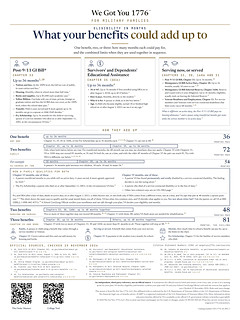
The Post-9/11 GI Bill pays up to 36 months of benefits.
It pays tuition and fees to the school, a monthly housing allowance, and up to $1,000 a year for books and supplies, $41.67 a credit for up to 24 credits.
The Post-9/11 GI Bill pays no housing allowance to a member on active duty, or to a spouse using transferred months while the member or that spouse is on active duty. For a child using transferred months the law sets the member’s active duty aside; on the child’s own, sources differ: VA’s regulation (38 CFR 21.9571) sets it aside too, while the law (38 U.S.C. 3313(j)) pays housing only for the days off active duty and VA’s rates page (October 13, 2026) says a person on active duty gets none. VA decides.
The Defense Department decides transfers. A member with at least 6 years of service who agrees to 4 more can transfer up to 36 of the months the member has not used to a spouse or children, requested through milConnect while still serving. DoD's guide says the member must be eligible to be retained for those 4 years and not kept from serving them by policy or law.
A parent can split the months among family members in any amount, and can change the split or take months back later for months not yet used. VA's regulation counts the months for a term as used from the term's first day, and VA says it awards transferred months at the start of each term, so the months for a term that has begun cannot be changed.
DEA (Chapter 35) is for the spouse or child of a Veteran VA has found permanently and totally disabled by a service-connected disability, or who died of one or in the line of duty, plus less common cases VA lists (missing, captured or detained, hospitalized). A death of any cause with that permanent and total rating in effect counts too.
DEA pays up to 36 months to a person who first enrolled in a program using DEA on or after August 1, 2018, and up to 45 to one who first enrolled using it before.
DEA pays a monthly payment directly to the student, who pays the school. It has no housing allowance or book stipend.
A child who became eligible, turned 18 or finished high school on or after August 1, 2023 can use DEA at any age with no time limit. Otherwise a child generally uses it between 18 and 26, with exceptions in the law: when VA first finds the parent permanently and totally disabled, or the parent dies, after the child turns 18 and before 26, the child has 8 years from a start date set with VA; a child who serves in the Armed Forces between 18 and 26 has 8 years from the first discharge, but not past age 31; and active duty under certain orders during the period adds that time plus four months. VA lists the other cases.
The Fry Scholarship is for the child or surviving spouse of a service member who died in the line of duty on active duty on or after September 11, 2001; of a Selected Reserve member who died on or after September 11, 2001, in the line of duty or from a service-connected disability; or, for terms that start before October 1, 2027, of a member who died from a service-connected disability within 120 days of leaving service.
Fry pays up to 36 months at the Post-9/11 GI Bill's full rate: tuition and fees, housing and books.
Yellow Ribbon is a voluntary agreement in which a school and VA share tuition and fees above what the Post-9/11 GI Bill pays. The school sets how much it pays a student a year, which can differ by student level (certificate, undergraduate, graduate, doctoral) or by college or professional school within it, and for how many students, and VA matches it. The school gives its places first come, first served to eligible students who apply the way the school sets, and keeps paying in later years while the student makes satisfactory progress and the school stays in the program. It needs the 100 percent level, and only participating schools take part.
The Montgomery GI Bill Active Duty (Chapter 30) and Selected Reserve (Chapter 1606) pay up to 36 months each, and Veteran Readiness and Employment (Chapter 31) up to 48.
VA pays one education benefit at a time. A person eligible for more than one chooses which to use, and can use them one after another.
Chapter 35 combined with other VA education programs is limited to 81 months.
A family holding 36 months of each can use both in full, one at a time: 72 months, inside the 81.
Two or more programs from a person’s own service (Chapters 30, 33 and 1606 among them) are limited to 48 months together, and by law Chapter 31 with them to 48 unless VA finds more are needed. VA’s VR&E page (November 24, 2026) says it subtracts GI Bill months used first from Chapter 31’s 48, and does not subtract Chapter 31 months from the GI Bill; an example in VA’s education manual (Part 4, 3.06, October 30, 2026) does subtract them. VA decides.
Fry with DEA: after a death in the line of duty on active duty on or after August 1, 2011, a child chooses one, or uses both only when DEA comes from a different event, which VA caps at 48 months; before that date, both, capped at 81. The law and VA’s pages state the child’s choice only for a death in the line of duty on active duty; when Fry comes from a Selected Reserve death or a death within 120 days of leaving service, VA decides how the two apply. A spouse picks one and cannot switch, apart from a choice made before December 16, 2016 when the member died from September 11, 2001 through December 31, 2005 (38 U.S.C. 3311). Only one program is used at a time. VA’s 48 sits against the 81 in 38 U.S.C. 3695(c) and 38 CFR 21.4020(c).
Housing pays only above half time. At exactly half time, 6 credits where 12 is full time, it pays nothing.
At the 100 percent level the Post-9/11 GI Bill pays the full net cost of in-state tuition and fees at a public school: what is left after any tuition waiver or reduction and any aid paid to the school only for tuition and fees.
The School Certifying Official certifies enrollment to VA and can talk through a plan. VA decides eligibility and months.
VA's education line is 888-GIBILL-1 (888-442-4551), Monday through Friday, 8:00 a.m. to 7:00 p.m. Eastern. From outside the United States, VA lists 001-918-781-5678 at the same hours; it is not toll-free.
The Montgomery GI Bill Active Duty (Chapter 30) generally must be used within 10 years of the last discharge or release from active duty, and the Montgomery GI Bill Selected Reserve (Chapter 1606) generally ends on the day the member leaves the Selected Reserve. The law and VA list exceptions.
The Post-9/11 education benefit: up to 36 months that pay tuition and fees to the school, a monthly housing allowance set by the campus ZIP code, and a payment for books and supplies, by the credit up to a yearly cap. How much of the tuition and housing it pays depends on how long the member served (the eligibility tier), except that a Purple Heart recipient, or someone discharged for a service-connected disability or sole survivorship after at least 30 continuous days on active duty, is paid at the 100 percent level.
Giving Post-9/11 GI Bill months to a spouse or children, the member’s dependents in DEERS. The Defense Department decides it: a member with at least 6 years of service who agrees to 4 more can transfer up to 36 of the months the member has not used, requested through milConnect while still serving. VA’s rule calls it transfer of entitlement.
Chapter 35 DEA (Survivors’ and Dependents’ Educational Assistance) G-03
A VA program for the spouse or child of a Veteran VA has found permanently and totally disabled by a service-connected disability, or who died of one or in the line of duty. A death of any cause with that permanent and total rating in effect counts too. DEA pays a monthly payment directly to the student, who pays the school, in steps by training time, and has no housing allowance or book stipend.
A VA education benefit for the child or surviving spouse of a service member who died in the line of duty on active duty on or after September 11, 2001, plus the Selected Reserve and after-service cases VA lists, paid at the Post-9/11 GI Bill’s full rate.
The GI Bill’s monthly housing payment: DoD’s Basic Allowance for Housing for an E-5 with dependents at the ZIP code of the campus where the student attends most classes. Schools abroad use one foreign rate instead, and a U.S. school’s campus abroad may not get the home campus rate.
How VA measures a course load. VA counts 14 credits a term as full time unless the school certifies 12 or 13 for its undergraduates. Where 12 is full time, 9 to 11 is three-quarter time and 6 to 8 is half time; for graduate work, full time is what the school certifies, or 14 credits. Chapter 35 DEA pays in steps by it, and the GI Bill pays housing only above half time.
VA’s letter that a benefit is yours to use. A family member using transferred months gets one after applying to VA, online or with VA Form 22-1990e. VA sends it electronically, with mail as an option.
How We Got You 1776 delivers the rules of VA education benefits: each rule traced to its source, each change tracked, and each check dated in public view.
Published by We Got You 1776, LLC. Also on LinkedIn.
How the We Got You 1776 site delivers and checks the rules: dated pages, one register of sources, and Questions from the Field, one question at a time.
Published by We Got You 1776, LLC.
Sources (37)
The official sources this answer is built on, the law first, then the official pages.