Asked the way a student thinking about college asks
Does Chapter 35 pay for online classes?
Yes, but Chapter 35 (DEA) pays for a class taken entirely online only in a VA-approved, accredited program leading to a standard college degree, an associate degree or higher. The wider rule that lets the GI Bill® pay for some online certificate programs does not apply to DEA, and VA does not pay for remedial or deficiency courses taken online. The law sets DEA’s monthly payment for school by training time, with no separate rate for online college classes.
Before you enroll online, find out whether VA has approved the program at that school, whether it is accredited, and whether it leads to a standard college degree, an associate degree or higher. If one is missing, DEA does not pay for a class taken entirely online in it. The payment goes by training time and comes to you, and you pay the school.
VA’s School Certifying Official Handbook says distance learning not leading to a degree may not be certified under Chapter 35. It also says resident and distance credit are reported separately only for the Post-9/11 GI Bill.
An online certificate can decide which benefit your child uses: the wider rule that lets the GI Bill pay for some online certificate programs does not apply to DEA. VA pays one education benefit at a time, and a child eligible for more than one chooses which to use.
There is no separate rate for online college classes: the law sets DEA’s monthly payment for school by training time. VA’s page says the payment goes by the credits, the dates of the term and active duty status, where the Post-9/11 GI Bill also looks at whether classes are in person or online.
Will Chapter 35 pay for an online trade or certificate course?
Not when it is taken entirely online and does not lead to a standard college degree, an associate degree or higher. VA’s School Certifying Official Handbook says distance learning not leading to a degree may not be certified under Chapter 35. Correspondence training is a separate kind that only a spouse or surviving spouse can use on DEA.
What do I ask an online school before using Chapter 35?
Ask the certifying official whether VA has approved the program at that school, whether it is accredited, and whether it leads to a standard college degree, an associate degree or higher. VA’s DEA page sends families to the GI Bill Comparison Tool, or to the certifying official, to find which programs VA has approved.
Can transferred GI Bill months pay for an online certificate?
They may, where DEA does not. A wider rule lets the GI Bill pay for some online certificate programs, and it does not apply to DEA. VA approves programs at a school, not the school as a whole, and pays one education benefit at a time, so a student eligible for both chooses which to use.
Can a child use correspondence courses on Chapter 35?
No. On DEA only a spouse or surviving spouse can use correspondence training. VA’s DEA rates page says its lessons can be completed online, and it is a separate kind from online college classes.
On Chapter 35 (DEA), the program decides whether a class taken entirely online is paid. VA has to have approved the program at that school, and it has to be accredited and lead to a standard college degree, an associate degree or higher. An online program that meets all three is paid each month by training time, as one on campus is.
A class taken entirely online in a certificate or trade program that does not lead to a degree is outside that rule. VA’s School Certifying Official Handbook says distance learning not leading to a degree may not be certified under Chapter 35. The GI Bill has a wider rule that lets it pay for some online certificate programs, and that rule does not apply to DEA. One online certificate can be payable for a student on the GI Bill and closed to a student on DEA.
DEA pays by training time. The law sets its monthly payment for school that way, with no separate rate for online college classes, and VA’s page says it goes by the credits, the dates of the term and active duty status. The Post-9/11 GI Bill also looks at whether classes are in person or online, and VA’s handbook has resident and distance credit reported separately only for that benefit. DEA has no housing allowance, so there is none to cut for online study. In an approved degree program, taking a class on campus instead of online leaves the DEA payment where it is, apart from a remedial or deficiency course, and a change in credits can move it a step.
Inside a degree program one kind of online class is still left out. VA does not pay for remedial or deficiency courses taken online, and VA’s School Certifying Official Handbook says the same of a hybrid format, so a student placed in one asks the school how it is taught before registering.
Correspondence training is a separate kind of study. VA’s DEA rates page says its lessons can be completed online, and only a spouse or surviving spouse can use it on DEA.
The school can settle most of this before the term. VA approves programs at a school, not the school as a whole, and VA’s DEA page sends families to the GI Bill Comparison Tool, or to the school’s certifying official, to find which programs it has approved. A certificate program that mixes online classes with sessions on campus is one to take to the certifying official and to VA before enrolling. The certifying official certifies the enrollment, and VA decides eligibility.
The Short. The answer as a short video, with captions and a transcript.Transcript
Asked, plainly. Does Chapter 35 pay for online classes? Asked the way a student thinking about college asks
Yes, but Chapter 35 (DEA) pays for a class taken entirely online only in a VA-approved, accredited program leading to a standard college degree, an associate degree or higher.
The wider rule that lets the GI Bill pay for some online certificate programs does not apply to DEA, and VA does not pay for remedial or deficiency courses taken online.
The law sets DEA’s monthly payment for school by training time, with no separate rate for online college classes.
The law behind it. 38 U.S.C. 3523, 38 CFR 21.3130. The full answer is at wegotyou1776.com/questions
We Got You 1776. Plan around your education benefits. wegotyou1776.com/questions
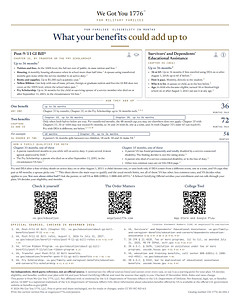
The Post-9/11 GI Bill pays up to 36 months of benefits.
It pays tuition and fees to the school, a monthly housing allowance, and up to $1,000 a year for books and supplies, $41.67 a credit for up to 24 credits.
The Post-9/11 GI Bill pays no housing allowance to a member on active duty, or to a spouse using transferred months while the member or that spouse is on active duty. For a child using transferred months the law sets the member’s active duty aside; on the child’s own, sources differ: VA’s regulation (38 CFR 21.9571) sets it aside too, while the law (38 U.S.C. 3313(j)) pays housing only for the days off active duty and VA’s rates page (October 13, 2026) says a person on active duty gets none. VA decides.
The Defense Department decides transfers. A member with at least 6 years of service who agrees to 4 more can transfer up to 36 of the months the member has not used to a spouse or children, requested through milConnect while still serving. DoD's guide says the member must be eligible to be retained for those 4 years and not kept from serving them by policy or law.
A parent can split the months among family members in any amount, and can change the split or take months back later for months not yet used. VA's regulation counts the months for a term as used from the term's first day, and VA says it awards transferred months at the start of each term, so the months for a term that has begun cannot be changed.
DEA (Chapter 35) is for the spouse or child of a Veteran VA has found permanently and totally disabled by a service-connected disability, or who died of one or in the line of duty, plus less common cases VA lists (missing, captured or detained, hospitalized). A death of any cause with that permanent and total rating in effect counts too.
DEA pays up to 36 months to a person who first enrolled in a program using DEA on or after August 1, 2018, and up to 45 to one who first enrolled using it before.
DEA pays a monthly payment directly to the student, who pays the school. It has no housing allowance or book stipend.
A child who became eligible, turned 18 or finished high school on or after August 1, 2023 can use DEA at any age with no time limit. Otherwise a child generally uses it between 18 and 26, with exceptions in the law: when VA first finds the parent permanently and totally disabled, or the parent dies, after the child turns 18 and before 26, the child has 8 years from a start date set with VA; a child who serves in the Armed Forces between 18 and 26 has 8 years from the first discharge, but not past age 31; and active duty under certain orders during the period adds that time plus four months. VA lists the other cases.
The Fry Scholarship is for the child or surviving spouse of a service member who died in the line of duty on active duty on or after September 11, 2001; of a Selected Reserve member who died on or after September 11, 2001, in the line of duty or from a service-connected disability; or, for terms that start before October 1, 2027, of a member who died from a service-connected disability within 120 days of leaving service.
Fry pays up to 36 months at the Post-9/11 GI Bill's full rate: tuition and fees, housing and books.
Yellow Ribbon is a voluntary agreement in which a school and VA share tuition and fees above what the Post-9/11 GI Bill pays. The school sets how much it pays a student a year, which can differ by student level (certificate, undergraduate, graduate, doctoral) or by college or professional school within it, and for how many students, and VA matches it. The school gives its places first come, first served to eligible students who apply the way the school sets, and keeps paying in later years while the student makes satisfactory progress and the school stays in the program. It needs the 100 percent level, and only participating schools take part.
VA pays one education benefit at a time. A person eligible for more than one chooses which to use, and can use them one after another.
Chapter 35 combined with other VA education programs is limited to 81 months.
A family holding 36 months of each can use both in full, one at a time: 72 months, inside the 81.
Fry with DEA: after a death in the line of duty on active duty on or after August 1, 2011, a child chooses one, or uses both only when DEA comes from a different event, which VA caps at 48 months; before that date, both, capped at 81. The law and VA’s pages state the child’s choice only for a death in the line of duty on active duty; when Fry comes from a Selected Reserve death or a death within 120 days of leaving service, VA decides how the two apply. A spouse picks one and cannot switch, apart from a choice made before December 16, 2016 when the member died from September 11, 2001 through December 31, 2005 (38 U.S.C. 3311). Only one program is used at a time. VA’s 48 sits against the 81 in 38 U.S.C. 3695(c) and 38 CFR 21.4020(c).
Housing pays only above half time. At exactly half time, 6 credits where 12 is full time, it pays nothing.
At the 100 percent level the Post-9/11 GI Bill pays the full net cost of in-state tuition and fees at a public school: what is left after any tuition waiver or reduction and any aid paid to the school only for tuition and fees.
The School Certifying Official certifies enrollment to VA and can talk through a plan. VA decides eligibility and months.
VA's education line is 888-GIBILL-1 (888-442-4551), Monday through Friday, 8:00 a.m. to 7:00 p.m. Eastern. From outside the United States, VA lists 001-918-781-5678 at the same hours; it is not toll-free.
The Post-9/11 education benefit: up to 36 months that pay tuition and fees to the school, a monthly housing allowance set by the campus ZIP code, and a payment for books and supplies, by the credit up to a yearly cap. How much of the tuition and housing it pays depends on how long the member served (the eligibility tier), except that a Purple Heart recipient, or someone discharged for a service-connected disability or sole survivorship after at least 30 continuous days on active duty, is paid at the 100 percent level.
Giving Post-9/11 GI Bill months to a spouse or children, the member’s dependents in DEERS. The Defense Department decides it: a member with at least 6 years of service who agrees to 4 more can transfer up to 36 of the months the member has not used, requested through milConnect while still serving. VA’s rule calls it transfer of entitlement.
Chapter 35 DEA (Survivors’ and Dependents’ Educational Assistance) G-03
A VA program for the spouse or child of a Veteran VA has found permanently and totally disabled by a service-connected disability, or who died of one or in the line of duty. A death of any cause with that permanent and total rating in effect counts too. DEA pays a monthly payment directly to the student, who pays the school, in steps by training time, and has no housing allowance or book stipend.
The GI Bill’s monthly housing payment: DoD’s Basic Allowance for Housing for an E-5 with dependents at the ZIP code of the campus where the student attends most classes. Schools abroad use one foreign rate instead, and a U.S. school’s campus abroad may not get the home campus rate.
How We Got You 1776 delivers the rules of VA education benefits: each rule traced to its source, each change tracked, and each check dated in public view.
Published by We Got You 1776, LLC. Also on LinkedIn.
How the We Got You 1776 site delivers and checks the rules: dated pages, one register of sources, and Questions from the Field, one question at a time.
Published by We Got You 1776, LLC.
Sources (19)
The official sources this answer is built on, the law first, then the official pages.